
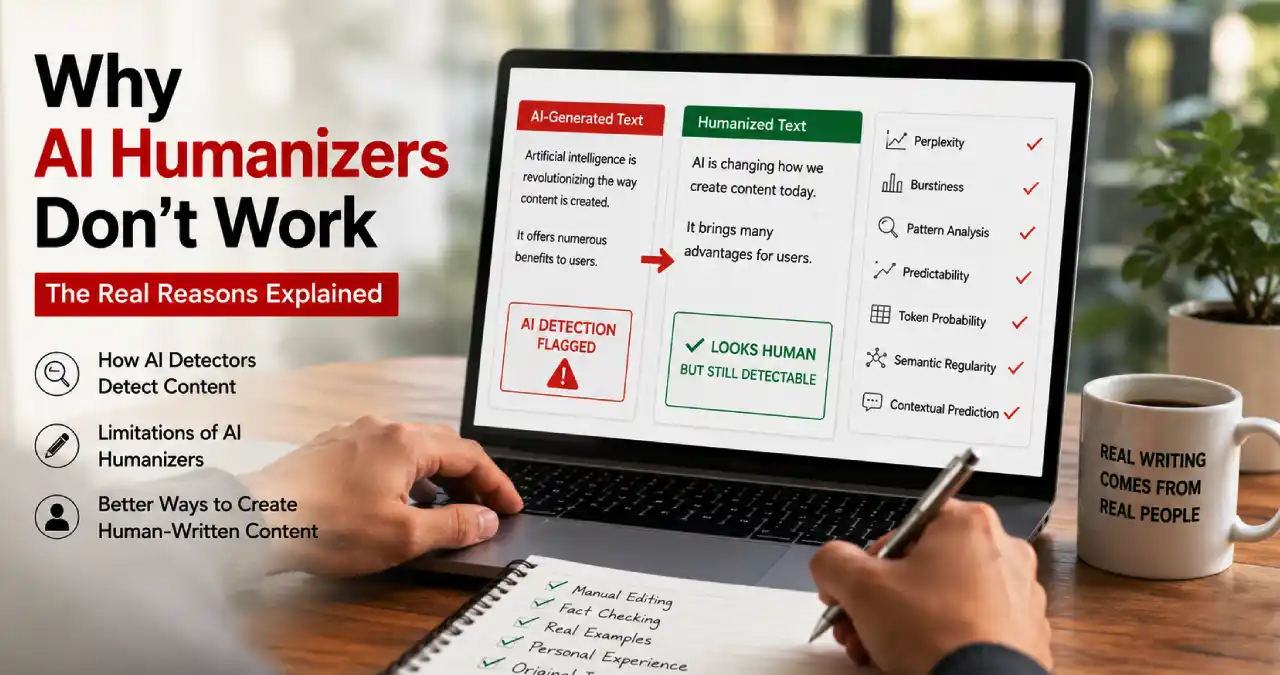

Sometimes AI humanizers stop working, but we need to know why AI humanizers don’t work.
AI humanizers indicate a system or unique tools to change robotic, AI-generated text to an engaging, natural, and personal style of writing. The AI writing tools write content in a new way, creating a new post. It can go through the AI detectors by sharing an authentic message.
Certain humanizers reduce detection scores, but they do not avoid the AI bypass tools. They are sentence length and vocabulary, without changing the inner statistical fingerprint in the text. The reasons behind the failure of AI humanizers are replacement at the surface level, predictability in data, loss of meaning, and absence of live experience.
In this Ainewsjournal article, the readers will discover the real reason behind the failure of AI humanizers, the role, and the function of free humanizers. It tells the process of identifying humanized text and the difference between AI humanizers and paraphrasers. Finally, it investigates the reason behind the flagging of LLM-generated text.
Table of Contents
Why AI Humanizers Don’t Work
The majority of the AI humanizers are basically paraphrasers. If you have any doubts about the true meaning, then it is really important to know the in-depth meaning of AI humanizer.
The tools use synonyms, write sentence structures, and replace words to write natural content. After critical analysis, we get an impression from the figures.
How AI Humanizers Work
AI humanizers rewrite the AI-formatted text through the replacement of words and rearrangement of sentences. It modifies the punctuation and changes the length of the sentence, along with the adjustment of tone.
The ultimate target is to create natural content and restore the actual meaning. However, the tools cannot change the inner statistical patterns that certain AI detectors assess.
Common Changes by AI Humanizers
- Substitute predictable words with new ones.
- Divides or adds sentences.
- Transforms passive voice to active voice
- Modifies punctuation.
- Uses contractions.
- Uses simple words.
- Arranging the clauses
Example of AI Mode and Humanized Mode
Let us get a clear idea with an example of the AI mode and humanized mode below.
Original AI
Social media has a major role in the recent strategies of digital marketing.
Social media has a major role in the recent strategies of digital marketing.
Humanized
Today, the majority of businesses use social media as it assists them in linking with customers and developing the brand.
Today, the majority of businesses use social media as it assists them in linking with customers and developing the brand.
How AI Detectors Detect Humanized Content
AI detectors interpret the nature of language in AI-assisted text. Most of the detection process depends on machine learning models for big datasets.
It includes AI-assisted content and human-written content. It depends on the detector, prompt, editing, and model.
- Language probability and predictability: AI writing tools create text by forecasting the next word in that context.
- Perplexity: Perplexity calculates the predictability of a writing to a reader.
- Burstiness: Shows the variation in sentence structure, length, and complication.
- Pattern analysis: AI detectors check the repetition in the structure of the sentence and vocabulary.
- Token probability: AI detectors check the synthetic text by analysing token probabilities using large language models.
- Semantic regularity: It is the regular topic transitions, logical pacing, and natural tone of Large Language Models.
- Contextual prediction: It is a system where the algorithms interpret syntactic, semantic, and structural flow in text.
Top Limitations of AI Humanizers
The demerits of AI humanizers are as follows:
- Irregular identification and a high rate of failure: The humanizers cannot decrease the detection scores even though they offer an attractive promise in marketing.
- Poor readability and odd phrasing: To control the algorithms, the humanizers change the pattern of sentences and words.
- Lack of genuine voice and authentic meaning: Absence of authentic voice and true meaning.
- False Sense of Security: Depends on an AI humanizer to predict the security and originality of content.
- Decline in the talent of writing and deep thinking: AI-assisted writing and adding a human tone for proper understanding.
Difference between AI Humanizers and Paraphrasers
| Feature | AI Humanizer | Paraphraser |
| Basic Goal | To add a human touch. | To write the passage again clearly. |
| Avoid AI detection tools | Decreases the syntax. | Modifies the stock of words |
| Central process | Rewriting the structure and length of the sentence. | Replacing synonyms and fundamental clauses. |
| Feeling of text | Spontaneous and varies in flow. | Correct the grammar. |
| Best used for | Automatic draft and SEO optimized content. | Detects plagiarism and grammatical errors. |
| Style of writing | Quite natural | Has the same meaning |
Why Humanized Content Still Gets Flagged
Humanized texts get a lot of flags for the following reason:
- Fake positives frequently occur: AI detectors apply variations like words and the structure of a sentence.
- Regularity in pattern and format of sentence: The sentence has the same tone and length. Then the humanizer acts like a machine.
- Too much passive voice and scholarly tone: Technical words and formality will activate the detectors.
- Absence of variation or personal attitude: Discover a generic style of narration and emotion.
- AI-guided rewriting: AI detectors will edit with external AI tools.
How to Improve AI Content Beyond Humanizers
The different ways of humanizing AI content are as follows:
- Combine the format and length of the sentence: Mix short with long sentences. Divide the regular phrases.
- Apply active voice frequently: Avoid using passive voice to increase the flow of the sentence and use active voice.
- Use examples or personal feelings: Adding personal opinions makes the writing feel more authentic.
- Bypass the application of technical terms: You can create a balance through general descriptions and restrict the common phrases.
- Editing by hand: It includes rearranging, deleting, adding a sentence, or removing words.
- Maintain previous drafts: Maintain the past drafts and history of revision for originality in writing.
Common Errors People Make in Humanizing AI
The general errors are as follows:
- Using synonyms randomly: AI humanizers apply synonyms at random.
- Applying complicated words: Sometimes, the AI humanizers use complex words.
- Applying passive voice: It is hard to follow an AI tool writing in passive voice.
- Deleting contractions: The language becomes natural with the removal of contractions.
- Excessive editing: A lot of editing is not required for natural writing.
Best Practices When Using AI Humanizers
- Research is the priority: The writer should give importance to research from authentic sources.
- Use experience: It is essential to add personal experience in writing to convince the readers.
- Manual editing: Manual editing is important for a human touch.
- Add examples: Examples tell us about similar situations.
- Quality: It checks the standard of content.
- Helpfulness: It examines the value of content.
- Authenticity: It explores the source of content writing.
Recommended Workflow for Humanizing AI Content
Original AI draft → AI humanizer → Manual editing → Fact-checking → Final proofreading
Based on the flowchart above, we believe the original AI content is passed through a humanizer. Then, manual proofreading takes place. Finally, the content is quite precise, natural, and customized.
Conclusion
Most AI humanizers rely on surface-level rewriting, such as synonym replacement and sentence restructuring. The main reasons why AI humanizers don’t work depend on replacing the word rather than rearranging ideas in a natural way. AI humanizers are important for enhancing readability, but they shouldn’t be depended on to avoid AI detection. The right approach is to add AI assistance with the best manual editing, original insights, and fact-checking to produce useful content.
FAQ
Do AI Humanizers pass through Turnitin?
No AI humanizer might pass through Turnitin. The detection relies on the standard of manual editing, rewriting, and a particular AI detector.
What is the best alternative to AI humanizers?
The perfect alternative to AI humanizers is manual editing, subject expertise, prompt engineering, and professional editing.
How does humanizing AI content affect SEO?
The ideal humanized content will enhance the involvement of the user and readability. Besides, it will improve the SEO. Low-quality humanization might decrease the position in search engines and faith.
Can Google identify AI content?
Google rewards useful content irrespective of how it was created. It points out whether the writing is AI-assisted. Rather, its method depends on pointing out the standard of content.
Are AI detectors accurate?
No, AI detectors may not be completely dependable. The problems of reliability are the sudden flagging of human-written content as AI-assisted content.
Do AI humanizers remove plagiarism?
AI humanizers don’t remove plagiarism completely. But it can decrease the score of similarity by paraphrasing at the surface level.
Do you think manual editing is better than an AI humanizer?
Manual editing is truly great for adding genuine intention, nuance, and original personal voice to the project. The right way is to adopt a hybrid technique where the AI humanizer works along with manual editing.
Which AI detector is quite precise?
Reputed AI detectors are Originality.ai, GPTZero, Pangram Labs, Grammarly AI Detector, and Copyleaks, but none of them is completely precise. Various AI detectors create new results, and none of them is fully precise.



wonderful blog.
Thank you.