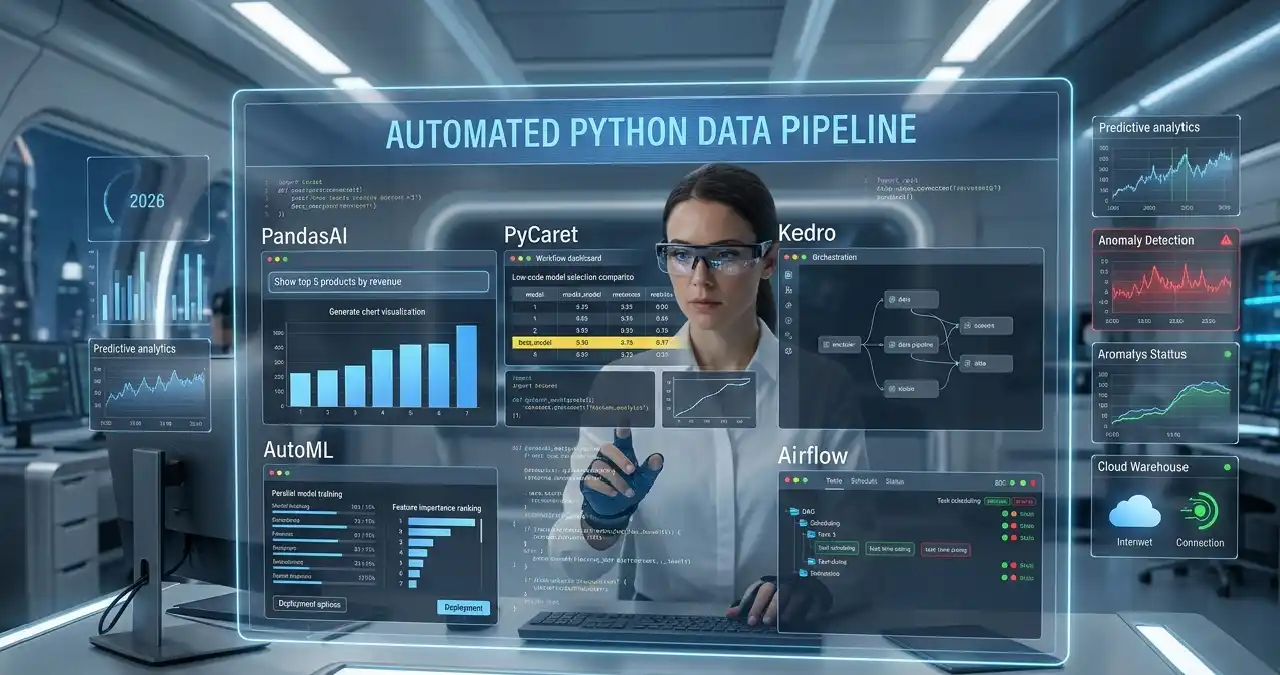

In 2026, AI tools automate data cleaning, feature engineering, and preprocessing tasks in Python workflows. Python is a major language for creating modern data analysis pipelines. AI-powered libraries change traditional workflows into growing automated pipelines. In this Ainewsjournal article, we talk about AI tools for automating Python data analysis pipelines. As we explore the development, the data teams can decrease repetitive coding activities and concentrate on strategic interpretation. It increases the planning at a high level. The basic benefit of Pandas AI is querying datasets in simple English. PyCaret automates the model selection and feature engineering. Automated pipelines decrease the time consumed in cleaning datasets. AI-guided pipelines change the fragmented data estate to a decision engine which creates, observes, and heals.
Table of Contents
What AI Automates Python Data Pipelines?
AI tools for Python data analysis are libraries that are responsible for automation of activities like feature engineering, data cleaning, pipeline orchestration and model selection.
Main Features to Look for in Automated Data Pipelines Python
The data analysis tools have some basic features, and they are as follows:
- Helps in natural language queries (data interaction using NLP).
- Predicts the trends in the future and shows the right path.
- Links with the data storage, such as cloud, Excel, and other data storage.
- Follows the law of data safety, access regulation and encryption.
- Automated missing value imputation applies an algorithm for completing missing data, substituting the old-fashioned methods.
- Duplicate removal and identification are an important part of automated data pipelines.
- Natural language querying helps users communicate with the analytics platform and database.
- Integration with cloud/data warehouses links the CRM and databases with a centralized cloud repository.
Key Automation Capabilities in Modern Python Pipelines
The importance of AI tools is as follows:
- These tools can debug and create Python scripts quickly.
- AI-guided algorithms find the anomaly instantly.
- It tackles schema development.
- AI-supported orchestration tools improve compute and storage materials in an automatic way.
- The hyperparameter tuning and model choice decrease fatigue and human bias automatically.
Popular AI Tools for Python Workflow Automation Tools
1. AutoML Libraries
AutoML libraries are responsible for automating machine learning systems. It consists of feature engineering. For increasing the development of the model, it includes model choice and hyperparameter tuning. It decreases the reliance on specialists and improves the output.
Basic Features
- Handles the numerical information.
- Creates new characteristics and points out the changing features using model output.
- Improves the setting of parameters.
- Offers a holistic assessment parameter.
- Bayesian Optimization works in the form of a search engine for the ideal configuration.
- Cross-validation indicates the assessment criteria to find out the effectiveness of the settings.
Pros
- Improves speed.
- Anybody can create top-quality models.
- Increases model output.
- Strong feature engineering.
Cons
- Restricted modification.
- High cost of computation.
- Power of overfitting.
- Reliance on data standards.
Pricing
- Open source AutoML Libraries – Free ( AutoGluon, Auto-SKlearn, TPOT, PyCaret).
- Commercial Cloud AutoML Services – Pricing is variable, and it depends on the application, like time of training, prediction appeals and storage.
Best for
AutoGluon, PyCaret, Auto-Sklearn, and Google Cloud AutoML.
2. PandasAI
Pandas AI presents a library in Python, which connects generative AI to the popular data analysis tool. It visualizes and improves dataframes through natural language.
Basic Features
- Matches with different generative AI tools.
- A user-friendly platform helps in the conversion of information into dashboards by avoiding code writing.
- Helps experts in the field of marketing, finance and healthcare.
- Works as a connector with LLM APIs and data, permitting us to send queries through natural language.
- Perfect for exploratory analysis by permitting the user to communicate with the data frames with the help of prompts in natural language.
Pros
- Applies NLP to permit people in query datasets.
- Creates graphs and charts straightaway without coding.
- Improves activities like augmentation and data cleaning.
- One can change data without coding.
Cons
- Creates wrong responses or presents confusing prompts.
- Slow response time, and it is not fit for live applications.
- Needs API keys and conducts probable expenses.
- Not perfect for handling data on a large scale.
Pricing
PandasAI presents an open-source version, but the advanced enterprise capacities include extra charges.
Best for
Best suited for small to medium datasets, but the performance might degrade on very big datasets.
Example code
from pandasai import SmartDataframe

import pandas as pd

df = pd.read_csv("sales.csv")

sdf = SmartDataframe(df)

sdf.chat("Show top 5 products by revenue")
3. PyCaret
PyCaret presents a low-code and open-source library on machine learning using Python, created for automating workflows in machine learning. It works as a wrapper for reputable libraries in machine learning, like CatBoost, LightGBM, etc.
Basic Features
- Creates a low-code setting by importing the module and initializing setup.
- Automates engineering through missing value imputation, categorical encoding, and data scaling.
- Helps in advanced modelling by feature engineering, and handling imbalance.
- Assists in the training, tuning and automatically compares models.
- The pipeline involves training and evaluation.
- PyCaret assists in automatic experiment tracking through connection with MLflow, metrics, logging hyperparameters, and models with the least code modification.
Pros
- Holistic workflow.
- Helps in instant comparison of multiple machine learning models.
- Assesses a model through analysis.
Cons
- Not fit for big datasets.
- Tough to change the inner functions.
- Creates problems for beginners due to automating them..
- It is not ideal for deep learning activities.
Pricing
Totally free.
Best for
Machine learning using low code, quick prototyping, and automating the machine learning pipeline. It is perfect for clustering, regression and classification in the industrial sector. It is applied in e-commerce, healthcare and finance.
Code Snippet
from pycaret.classification import *

exp = setup(data, target='label')

best_model = compare_models()

evaluate_model(best_model)
4.Kedro
Kedro is an open-source Python framework. It assists data scientists plus engineers in producing strong and modular data pipelines. It presents the perfect practice in software engineering for data science coding. It is important to automate data analysis pipelines using AI in Python.
Basic Features
- Helps in data logging and saving in Kedro related to the data catalogue for logging in Python.
- It has a structured design to apply the best practices of software engineering.
- Kedro helps in automating end-to-end data pipelines with growth..
- Pipeline abstraction is a way of decoupling logic in the data workflow from the technical application.
- Reproducibility guarantees running the pipeline again or the experiment giving regular output by removing hardcoded routes and secret states.
Pros
- Implements regular directory structure.
- Permits developers to switch from local storage to production storage.
- Divides complicated tasks into small activities.
- Helps in shifting code from the regional to the production level.
Cons
- Tough to learn for beginners.
- Needs refactoring of the present code to a strong pattern.
- Depends on outside tools for the production-related activities.
- Because of data handling issues, observing the problems in big assignments is tough.
Pricing
Completely free.
Best for
Reproducible data science, data pipelines and engineering, and RAG workflows.
How to Select the Perfect Python Workflow Automation Tools
- Pointing out the core target in automating, which includes user friendliness and security.
- Assess the major selection division, which are classified between the platforms for the pro-code developer and low-code platforms with integration of Python.
- The size of the dataset involves tool-type-based data scaling, like data orchestration tools and low-code platforms.
- Skill level of the group includes beginner, intermediate and advanced.
- Local versus cloud demand where the setup speed for local is low but in cloud, it is quite fast.
- Batch vs real-time processing, where real-time shows quick replies and batch shows a high latency.
- Cost vs expansion is based on usage-based pricing, AI-token costs and efficiency gains.
- Orchestration vs ML focus, where workflow orchestration deals with complicated processes and ML-focused on monitoring, deploying and training of machine learning models.
- Real-time vs batch pipelines, where the real-time pipelines organize data quickly after their arrival, while batch pipelines organize data in grouped intervals.
How to Create an AI-Assisted Python Data Pipeline
- Establish an AI-guided scenario.
- Take an AI assistant to create the basic activities of the pipeline.
- Connect with AI -supported tools.
- Approval and observation.
- Automating pipeline for regular activities.
- Example stack is PandasAI, PyCaret, Kedro and Airflow.
- Code snippets are essential for SEO.
Challenges of ML Pipeline Automation Libraries
- AI models face problems like irregular formats..
- Some AI-driven decision-making is tough to analyze.
- Modern frameworks in AI face problems in linking with old infrastructures.
- A lot of investment is essential for data cleaning.
- Data drift makes the code run, but the resulting analysis is not precise.
- The model reproducibility determines whether an experiment is reliable.
- Per-token pricing increases significantly with big datasets.
- Growth bottlenecks come from poor data transfer between stages and a lot of resource overhead in the computer.
- Data drift shows the statistical feature of our input that changes over time, causing a fall in the performance of the model.
- Debugging AI decisions needs to find out data transformation, approve medium-level production and observe the change in the concept.
Python Data Analysis Comparison Tools
| Feature | AutoML | PandasAI | PyCaret | Kedro |
| Primary Target | Automates the complete ML modelling lifecycle. | Visualization and analysis of conversational data | Quick and low-code ML experimentation. | Production-grade data engineering. |
| Interface | Programmatic or code-heavy | Natural language | Low code | Modular Python structure |
| Main automation | Hyperparameter tuning and model selection | Code creation for charts and queries. | Preprocessing of model comparison | Data versioning and orchestration. |
| Best for | Reaching the precision of the modern model. | Quick ad-hoc feedback. | Business analysts. | Data engineers creating rising products. |
| Core libraries | XGBoost, Scikit-learn. | LLMs and Pandas | LightGBM and XGBoost. | Custom |
| Scalability | Highly scalable | Highly efficient | Flexible | Highly scalable |
| Production Readiness | Very good for production. | Ideal for production. | Good for production | Perfect for production |
| LLM Integration | Improves speed. | Interaction with data frames. | Helps in automatic reporting | Creates functional workflows. |
| Real-Time Support | Offers quick forecasting | Helps in quick visualization. | Deploys trained models. | Assisted in AI-guided communication. |
| MLOps Capability | Automates the machine learning lifecycle. | Helps in data connectivity. | Deals with data preprocessing. | Splits monolithic code into nodes and pipelines. |
Example of Real Pipeline
PyCaret is an example of an AI tool which has a low-code library. It automates the complete machine learning system. It ranges from comparison of models to tuning of hyperparameters. It uses minimal coding.
Real-World Use Case
Forecasting and Predictive Analysis
Financial companies and retailers take the help of AI to predict customer demand and sales. For Pandas AI is a valuable tool for retailers to check the information on sales automatically and improve the computation of earnings.
Best Tool by Use Case
| Use Case | Best Tool |
| Beginner automation | Pycaret |
| Enterprise Orchestration | Airflow |
| Conversational Analytics | Pandas AI |
| Production pipelines | Kedro AI |
| Real-time orchestration | Prefect |
Future of automating data analysis pipelines using AI in Python
- Rise of independent AI agents with workflow orchestration and self-healing pipelines.
- Development of automated feature engineering.
- Most of the AI models will be taught synthetic data of high quality.
- Most of the enterprises will depend on AI-guided automation of data functions.
Conclusion
Automate Python data analysis in 2026 by selecting AI tools for code creation, cleaning, and producing a report to decrease manual effort considerably. Automating work can replace routine activities, link AI agents and help in automating data cleansing. The tool selection for beginners involves PandasAI for quick prototyping, LangChain for enterprise pipelines, and Apache Airflow with plugins for complex pipelines. Claude’s code for AI-supported debugging. Pycaret for Automated ML and reporting. In the future, the AI tools for automating Python will choose a multi-agent architecture, give importance to RAG, and create reusability.
FAQ
What are the main benefits of using these tools?
The main benefits of AI tools are accelerated growth and a decrease in workload, along with cleaning and data preparation being done intelligently. It enhances the speed of operation. It enhances the speed and live insights. It democratizes the reach of information.
Can AI autoheal a broken data pipeline?
Yes, AI-aided observability platforms can automatically find and solve some pipeline problems. It is from manual and reactive troubleshooting to independent DataOps. Using AI-guided observability, the models of machine learning identify and treat the faults. Some examples are missing data and schema drift.
Which tool is best for beginners to automate analysis?
If you are a fresher, you can try data analysis automation using PandasAI, LangChain, PyCaret, Kedro and Prefect. PandasAI and LangChain help in AI interaction through LLM orchestration. PyCaret assists in machine learning using low-code. Kedro offers a data engineering pattern.