
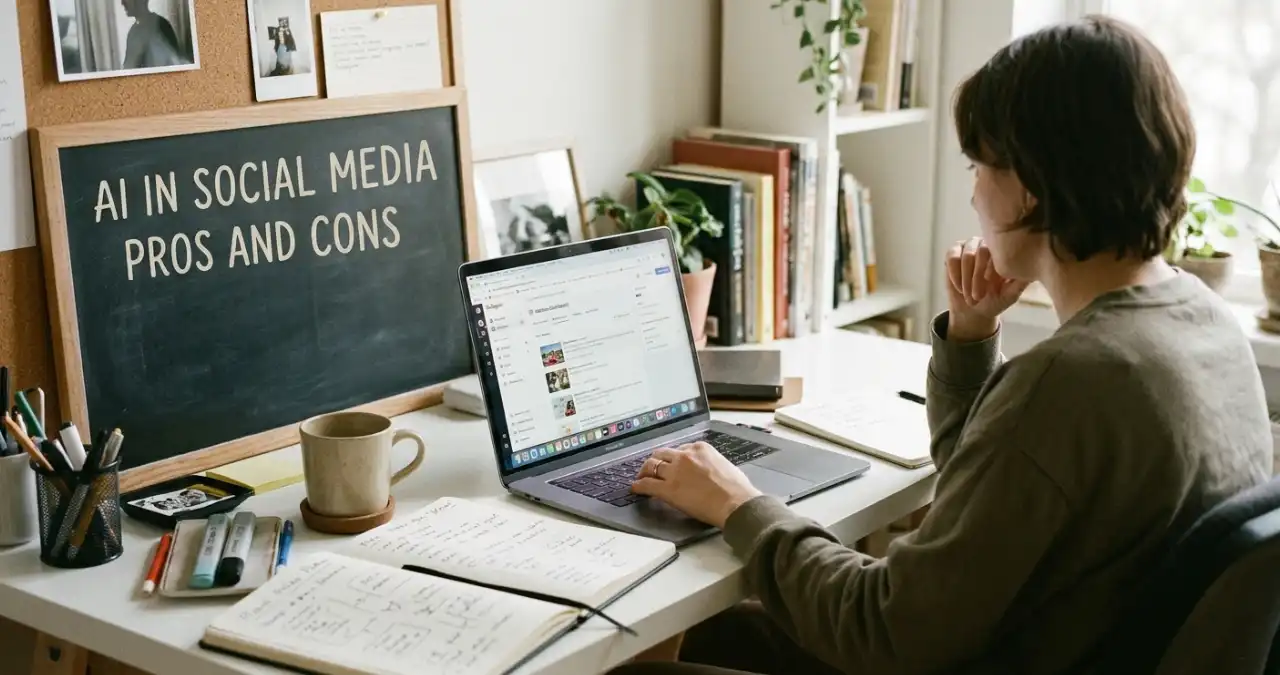
A couple of years ago, talking about AI in social media meant a clunky caption generator and a scheduling tool. Today, open TikTok, Instagram, or YouTube and you’ll struggle to tell what a person made and what a machine did. After spending a lot of time testing tools, scrolling feeds, and reading the latest reports, I’ve got a pretty clear view of the AI in social media pros and cons. Some of it is genuinely great. Some of it, a little annoying.
So let’s walk through both sides, with real examples from this year, and then I’ll tell you where I land.
Table of Contents
First, How Does AI Affect Social Media in 2026?
Short answer: it touches almost everything. According to Metricool’s 2026 study of more than 700 social media pros, about 95% now use AI at work.
But it isn’t only marketers. The platforms themselves use AI to decide what shows up in your feed, to label posts, to flag fake content, and even to help you write. That’s why the question of how AI affects social media in 2026 has two sides: what we do with AI, and what platforms do with it behind thAI in Social Media Pros and Cons: A quick comparison e scenes.
| What we’re looking at | Pros | Cons |
| Time | Hours saved on captions, scheduling, and reports | Easy to over-automate and lose the human touch |
| Content quality | Faster drafts, more ideas, polished visuals | Generic tone and “AI slop” risk |
| Reach (organic) | Better timing and consistent posting | Feeds crowded with synthetic content |
| Trust | Platform labels and detection are improving | Fake or unlabeled content still slips through |
| Cost | Small teams can compete with bigger brands | Platform rules and compliance add extra work |
| Kids and safety | Moderation tools are getting smarter | Low-quality AI videos reach children |
The Pros: Why I Like AI for Social Media (the Boons of AI)?
It gives you your time back
This is the big one. In 2026’s Constant Contact’s small business report, about half of small business owners using AI say saving time is its biggest benefit. And that matches what I’ve seen. Writing five caption options, finding hashtags, or turning one blog post into a week of posts used to eat my afternoon. With AI, it takes a fraction of that.
If you’re a one-person team, that’s not a small thing. It’s the difference between posting regularly and posting “whenever I remember.”
Makes organic posting more consistent
Organic reach is hard. You need consistency, good timing, and fresh ideas, and you don’t have an ad budget to cheat with. AI helps with all three: suggesting best posting times, brainstorming topics, drafting first versions, and summarizing what worked last month.
This matters because people now discover brands on social media. Constant Contact found that 49% of consumers use social media to find new small businesses, which beats search engines at 40%. If you want to see which tools are worth trying, our guide to AI tools for social media content creation is a good place to start.
Creating visuals and video is no longer a big-budget job
Free and cheap image generators, avatar tools, and video editors mean a small shop can now make polished content without a design team. If you’re curious, we’ve rounded up the best free AI image generators in 2026, the best AI video editing tools, and some top AI tools for generating UGC-style video content.
For paid social, it’s the same story. Tools now spin out multiple ad variations in minutes, which we cover in our post on the best AI tools for Facebook ad creative.
Better insights without the spreadsheet headache
AI can read your analytics and simply tell you what’s working. For anyone who dreads monthly reports, this is a gift.
Helps platforms detect and moderate harmful content
A positive trend that doesn’t get enough credit: On July 10 this year, TikTok officially published information that it has automatically labeled AI-generated content using content credentials and detection, and that ranges to over 3 billion videos. Meta rolled out a more unified AI disclosure approach across Instagram and Facebook earlier this year, and it also started labeling ads made with outside AI tools. YouTube made its AI labels more prominent in May 2026. It’s imperfect, but it’s moving in the right direction! Kudos!
The Cons: Why Is AI Bad for Social Media?
Now the other side. If you’ve ever wondered why AI is bad for social media, here’s where my own enthusiasm cools off.
The “AI slop” flood is real
This is the most visible problem. In Kapwing’s June 2026 test of a new TikTok account, 59% of the first 500 videos were AI slop. Lots of cheap, repetitive, soulless videos, made quickly and pushed out by the thousands, as compared to an older Kapwing test on YouTube Shorts, which came out at 21%
It’s the main reason many people feel like AI is taking over social media. When a feed fills up with the same weird, glossy, forgettable clips, it stops feeling social.
Kids are getting hit the hardest
In March 2026, Fairplay and about 200 experts urged YouTube to stop recommending AI slop to children. A New York Times investigation (February 2026) found that after a single CoComelon video, over 40% of the Shorts recommended in a 15-minute test session appeared to contain AI visuals. That’s a big deal, and it’s one of the strongest arguments against letting algorithms run unchecked.
Trust is getting shaky
When anything can be faked, people start doubting everything. Platforms are responding with labels, reporting tools, and detection (LinkedIn added a way for users to report suspected AI slop, and Substack added AI detection for some posts), but labels haven’t fixed the feed experience much. Many users, myself included, want a simple filter to hide AI content, and most platforms only offer a “show me less” option at best.
Labels can also go wrong. In 2024, Meta once tagged real photographs as “Made by AI” on Instagram and got serious backlash from photographers, then softened the label to “AI info.” Detection is still a work in progress.
Your content can start to sound like everyone else’s
When you let AI write everything, posts start to blend. Same tone, same phrases, same emoji pattern. Audiences notice. That’s why we always suggest adding your own voice, and we wrote about why AI humanizers don’t work and put together AI content writing style guidelines.
Stricter platform rules and disclosure requirements
If you skip disclosure on realistic AI content, platforms can cut your reach or worse. Reports on TikTok’s 2026 policy say repeated unlabeled AI uploads can lead to sharply reduced reach and paused creator earnings. And what you need to do differs by platform. Who’s responsible when AI goes wrong is a bigger question for businesses, which we dig into in AI transformation is a problem of governance.
Last but not least, AI video looks amazing in demos, but real-world use has gaps: consistency, realism, and control. We break these down in the limitations of using AI for video creation.
So, Is AI Taking Over Social Media?
Honestly? Partly. AI is deeply built into how content is made, ranked, and labeled. But ‘taking over’ makes it sound like humans are out of the picture, and that’s not what it is. The accounts that do well still have a clear point of view, real stories, and a human on the other end replying to comments.
Here’s the approach that has worked best for me:
- Let AI handle routine work: scheduling, first drafts, hashtag ideas, and reports.
- Keep the human parts human: your opinions, photos, behind-the-scenes content and replies.
- Edit everything: Never publish a raw AI draft. Go through it, fact-check the information and add your own touch.
- Label when needed: Follow each platform’s disclosure rules and update your process when they change.
- Check facts and images, especially anything that looks realistic.
If you’re building a toolkit on a budget, our list of free AI tools for marketing and the best AI writing tools will save you some trial and error. And since social and search are now overlapping, it’s worth reading about AI search optimization and how AI Overviews are affecting SEO for blogging.
In Closure
Weighing the pros and cons of AI in social media, I am a cautious fan. The boons of AI, such as speed, lower costs, and easier creativity, are real and useful, especially for small teams. The cons, from AI slop to eroding trust, are real too, and platforms are still catching up.
Use AI like a good assistant, not a replacement. Let it handle the grunt work, and keep the personality, the judgment, and the final say for yourself.
FAQs
What are the main pros and cons of AI in social media?
The main pros are time savings, easier content creation, better analytics, and more consistent posting. The main cons are a flood of low-quality AI content, weaker trust, generic-sounding posts, and stricter platform rules around labeling.
How does AI affect social media in 2026?
AI now shapes both sides of social media. Creators and brands use it to write, design, schedule, and analyze. Platforms use it to rank content, detect and label AI-generated posts, and moderate. Surveys this year show the large majority of social media professionals use AI regularly.
Is AI good for organic social media?
Yes, if you use it well. AI for organic social media is great for planning, drafting, timing, and reporting. It works best when you add your own voice and real experiences, because audiences can tell when a post feels generic.
Do I have to label AI-generated content?
Often, yes. TikTok, Meta, and YouTube all have disclosure rules for realistic AI content, and they also apply automatic labels when they detect it. Rules differ by platform and keep changing, so check the current policy before you post.
Will AI replace social media managers?
It’s more likely to change the job than erase it. Strategy, brand voice, community management, and judgment calls are still very human skills, while repetitive tasks are increasingly handled by AI.
How can I use AI on social media without hurting my brand?
Edit every draft, keep your own voice, fact-check, follow disclosure rules, and avoid mass-producing filler content. Treat AI as a helper that speeds you up, not as an autopilot.