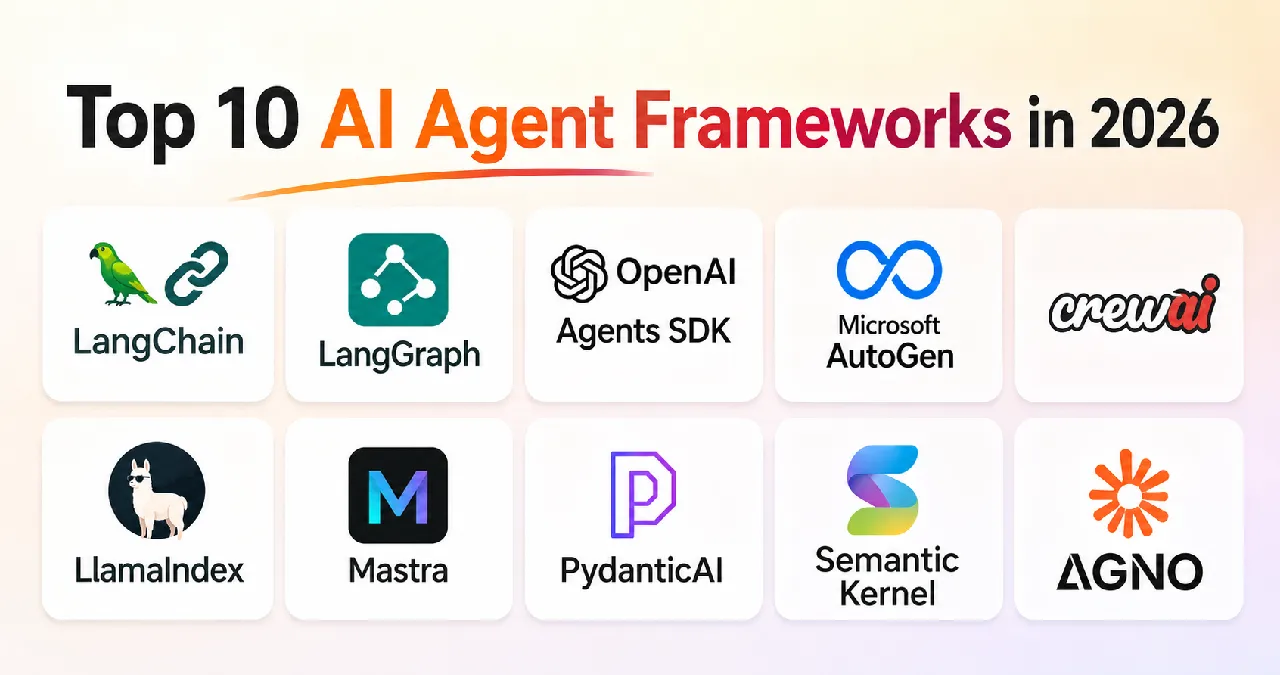

AI agent frameworks are toolkits that turn a base LLM into an autonomous, goal-driven system. It is a target-oriented process applying large language models to explain, apply tools, handle memory, and organize workflows. I tested popular AI agent frameworks, including LangChain, LangGraph, OpenAI Agents SDK, Microsoft AutoGen, CrewAI, LlamaIndex, Mastra, PydanticAI, Semantic Kernel, and Agno. These frameworks are based on the basic pillars like planning, memory, tools, and coordination.
In the Ainewsjournal blog, I will talk about the popular AI agent frameworks.
1. LangChain
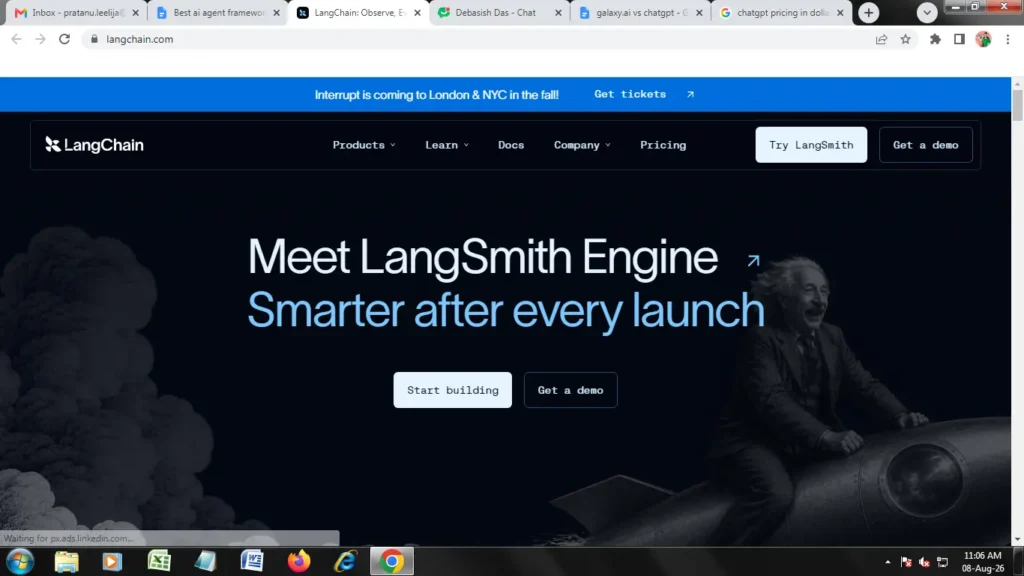
LangChain is an open-source orchestration framework created to improve application development supported through Large Language Models.
Features
- Helps in managing prompts.
- Links with the LLM providers and vector database.
- Keeps watch on the message history.
- Offers text splitting.
- Checks the user input.
Pros
- Creates active AI agents or chat applications.
- Links with document loaders, vector databases, and LLM providers.
- Exchanges the prompts or core models rather than writing the basic logic again.
- Uses companion tools for debugging and multi-agent loops.
Cons
- Fails to remember wrapper classes.
- Broken legacy code and APIs are unstable.
- The failure of the agent causes tracing errors.
- The framework creates additional expenses for ordinary text creation.
Pricing
- Developer: Free
- Plus: $39 / seat per month
- Enterprise: Contact the sales manager
Best for
Software developers, machine learning architects, and AI planners.
What’s new in 2026
I find important updates where LangSmith Sandboxes ensure the safety of code execution. The Context Hub is meant for versioning agent-shaping files. Finally, I believe LLM Gateway helps with data privacy and spend limits.
2. LangGraph
This is an open-source framework of LangChain to produce cyclical AI multi-agent workflows.
Features
- Edges and nodes are used in model agent logic.
- Permits agents to loop and retry past steps.
- Creates processes where agents communicate and work in groups.
- Keeps the shared states for instant updates.
Pros
- Works on free tasks for improving the pace.
- Helps in debugging and snapshot tracking.
- Checks the agent initiatives and stops the implementation.
- Permits agents to improve and assess the activities.
Cons
- Needs a learning graph-related mindset and tough schemas.
- Spoils the linear and fundamental workflow.
- Requires a framework-related pattern.
- Looks for the right database settings.
Pricing
LangGraph is completely free, and it is an open-source library.
Best for
Software programmers, machine learning designers, and AI masterminds.
What’s new in 2026
I found that LangGraph showed progress in 2026 as the top multi-agent orchestration framework. At the beginning of this year, in February, I discovered LangGraph 2.0. I came across protocol support for various agent systems. It has become a default engine for production-oriented stateful AI workflows
3. OpenAI Agents SDK
OpenAI Agents SDK is a simple orchestration framework. Being open source, it improves production and AI applications among different agents.
Features
- Offers LLMs based on instructions for tools and related activities.
- It’s an in-built implementation loop, which deals with calling tools and organizes the outcome.
- Supports TypeScript and Python.
- Improved for the models of OpenAI.
Pros
- One can learn easily through Python.
- Shifts the context and control among the special agents.
- Presents authentic output and input approval.
- Checks debugging tool calls and creative visualization.
Cons
- Advanced features do not get support from LLM providers.
- Absence of a framework for planning.
- It fails to deal with complicated queries.
Pricing
It is open-source and free to use.
Best for
Software coder and AI inventor.
What’s new in 2026
In 2026, I have found development of the OpenAI Agents SDK into a production-oriented framework for multi-agent systems. The recent updates are a model-native harness for agent loops with native secure sandbox performance and file allowance. Besides, I have found session snapshotting. Again, there is rehydration and Model Context Protocol assistance.
4. Microsoft AutoGen
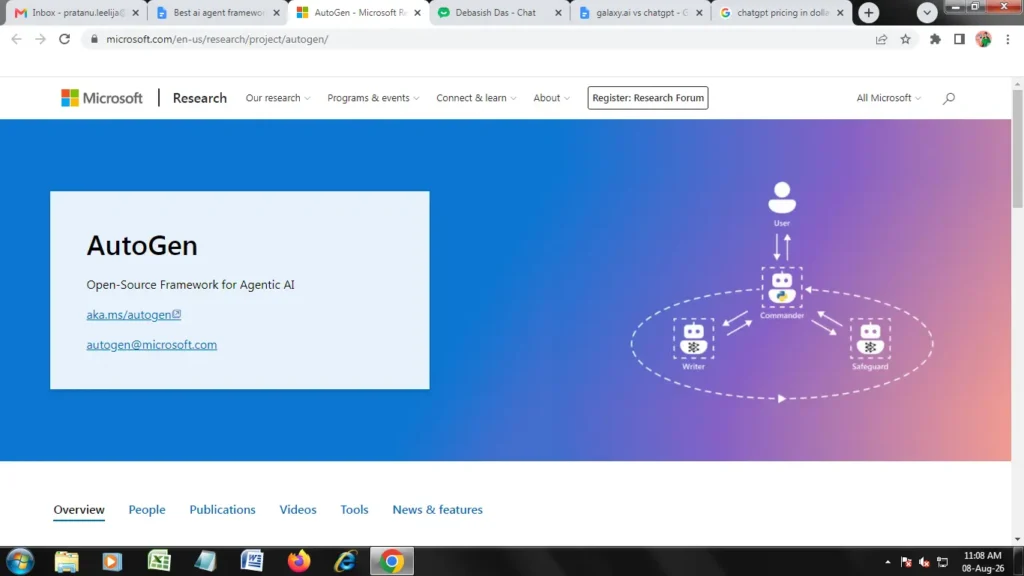
Microsoft AutoGen is an open-source framework for programming to create multi-agent AI processes.
Features
- The agents can find solutions to complicated assignments, web search, and coding.
- Created for strong applications where agents work for a long time.
- Arrange workflows to stop for human approval.
- The agents have the power to create code and apply unique tools.
- Works in different languages like .NET and Python for extensions and model clients.
Pros
- Deals with complicated projects and communication.
- The agents have the power to create and debug code.
- Connects the activity in the interaction loops of the agent.
Cons
- Needs good knowledge of Python and agent design.
- The attention is primarily on Microsoft Agent Framework.
- AutoGen is meant for security and bug patches.
- Absence of perseverance in high-level distributed scaling.
Pricing
This is an open-source platform with an MIT license without any paid tiers or subscription.
Best for
Software coders, machine learning architects, and AI engineers.
What’s new in 2026
I discovered that Microsoft has developed from the initial AutoGen to a repair mode in 2026. I showed that a new growth in the official successor, e.g., Microsoft Agent Framework. I found that it showed 1.0 general availability in April 2026. Classic AutoGen gets security and bug fixes. But the ecosystem shifts to a common framework.
5. CrewAI

CrewAI is a renowned open-source network for Python-based autonomous AI agents and role-playing to work on complex tasks.
Features
- The agents have specific targets and responsibilities to increase accuracy.
- Allows unique activities with the best narration.
- Helps in carrying out tasks stepwise and processes in a hierarchy.
- Creates an event-based framework linked with the team.
Pros
- User-friendly design.
- Quick prototyping.
- Matches with LLM providers and tools of LangChain.
- Offers a strong framework without any charges.
- Helps in reducing chaos by hierarchical and sequential workflows.
Cons
- High-level enterprise scaling is quite costly.
- Strong knowledge of Python is essential for custom agents.
- It is tough to find mistakes in the advanced orchestration.
Pricing
- Free: $0
- Custom: Contact the sales manager
Best for
Data analysts, software programmers, and AI engineers.
What’s new in 2026
I find the development of CrewAI from an ordinary linear agent wrapper to a primary enterprise multi-agent website. Then, I came across the news of graph-oriented Flows whose goal is to establish deterministic orchestration, along with the native Model Context Protocol help. I believe that it can provide an efficient tool for sharing with the best runtime safety integration across enterprise platforms like NVIDIA NemoClaw.
6. LlamaIndex
LlamaIndex is an open-source framework for linking data with custom data sources with Large Language Models like Gemini, Claude, or GPT-4.
Features
- Connects with the data sources through LlamaHub.
- Acts as a document parser to deal with handwritten notes, document layout, and embedded images.
- Changes the document without format to schema-oriented feedback.
- Organizes data for semantic search.
- Converts queries in natural language to accurate lookups.
Pros
- Presents guidance in query decomposition and recursive retrieval.
- Offers data loaders to organize tables, PDFs, cloud storage, and SQL databases.
- Needs little custom code to organize indexing and parsing of documents.
Cons
- It is tough to debug due to low-level calls in the API.
- It is not easy to learn query pipelines and retrieval strategies.
- Big datasets need embedding cost management and regular re-indexing.
Pricing
- Free: $0
- Starter: $50 per month
- Pro: $500 per month
- Enterprise: Contact the sales manager.
Best for
Backend programmers, data technologists, AI designers, enterprise knowledge supervisors, and financial experts.
What’s new in 2026
I found that LlamaIndex has developed from a fundamental prototyping library of RAG to an agentic document-processing environment in 2026. I discovered the latest updates to LlamaSheets for extracting structured financial data. Then, LlamaSplit has helped me in document classification. Finally, LiteSearch helps with local retrieval with API v2 recreated for LlamaParse, along with the native Workflows in several stages.
7. Mastra
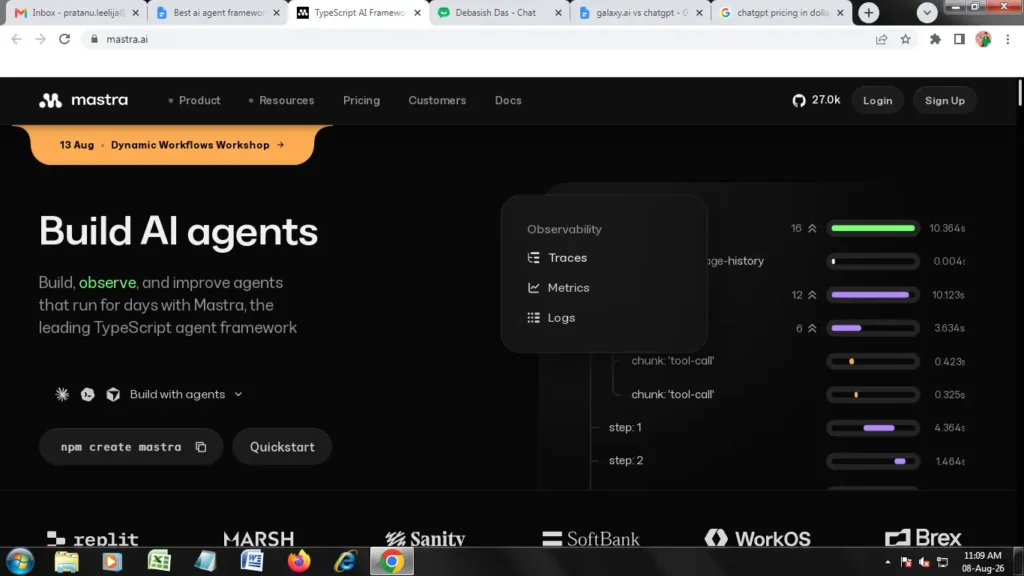
Mastra is a production-oriented and open-source TypeScript framework. It helps independent AI agents and complicated LLM applications.
Features
- Works as independent agents for organizing targets.
- Links with various LLM providers.
- Creates deterministic pipelines.
- Stops the assignments for user feedback.
Pros
- Offers native TypeScript assistance.
- Presents a framework for workflow, agent memory, and programmatic testing.
- Free for everyone with a developer ecosystem.
- Remarkable streaming facility.
Cons
- This is restricted to a TypeScript or JavaScript environment.
- Payment in external API keys is important.
- Needs framework-related ideas for management.
Pricing
- Starter: Free
- Teams: $250 per month
- Enterprise: Contact the sales manager.
Best for
JavaScript and TypeScript programmers.
What’s new in 2026
I found that Mastra AI has launched the 1.0 architecture release plus a wide range of improvements. I am surprised to know that it improved the basic agent loops along with the memory systems. I am glad to find the storage integrations and tracing.
8. PydanticAI
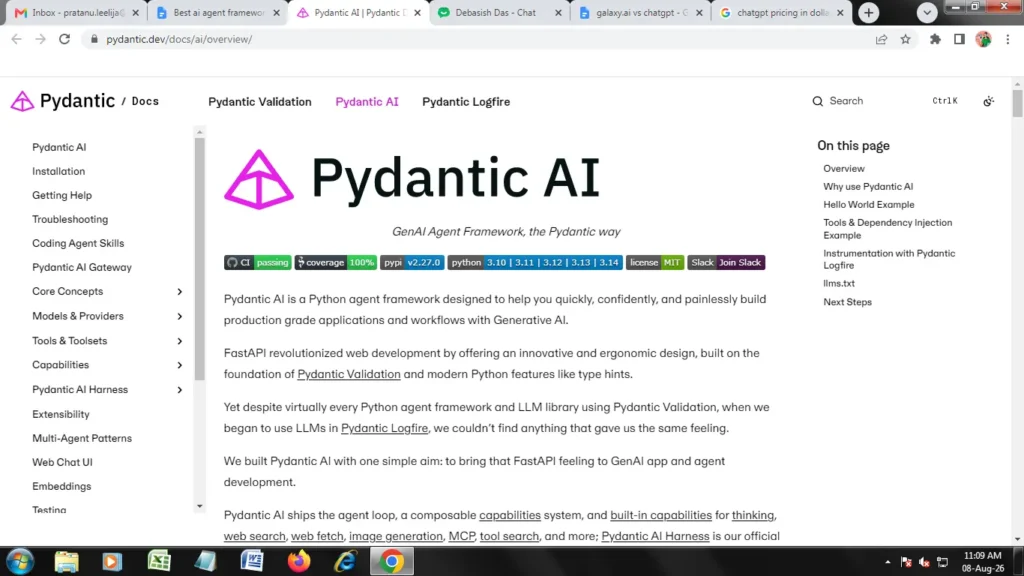
PydanticAI is an agent framework based on Python for creating Generative AI applications in production.
Features
- Ensures schema and security approval in the model outputs.
- Runs smoothly on the major LLM providers.
- Adds runtime dependencies easily within the agent tools.
- Creates JSON schemas automatically.
- Connects through Pydantic Logfire for checking latency and tracing calls.
Pros
- Links with different tools for checking token costs and debugging.
- Changes among primary model providers in the absence of vendor lock-in.
- Python code is readable without any kind of abstraction.
Cons
- Absence of workflow creator.
- Improving the prompts and dealing with complicated cases might be tough.
- Dependence on JSON schemas and model tool calling enhances the cost.
- Avoids a big library of SaaS integrations and concentrates on developer and core logic tools.
Pricing
PydanticAI indicates an open-source and free agent framework in Python. It has an MIT license without any cost.
Best for
Data architect, backend software engineer, and AI inventor..
What’s new in 2026
I discovered that PydanticAI had attained a primary stable v2.0.0 release on June 23, 2026. I found the launch of a leaner core with native composable power. It had developed model orchestration. I am glad to find an improvement in the level of a production-oriented and type-safe framework, helping Python AI agents.
9. Semantic Kernel
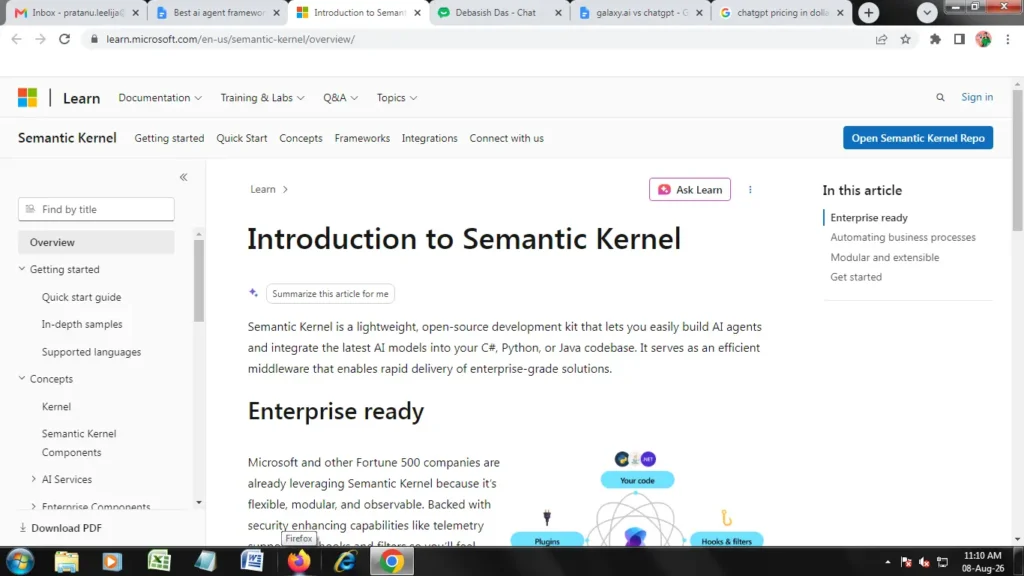
Semantic Kernel is an open-source software development kit from Microsoft.
Features
- Shifts among the model providers, e.g. Hugging Face, Google Gemini, Azure OpenAI, etc.
- Models can follow OpenAI specs and API as general code.
- Helps LLMs to analyze user intent.
- Creates a RAG pipeline by linking to a vector database.
Pros
- Offers stability in APIs and other forms of enterprise.
- Runs through Azure services and dependency injection.
- Connects through prompts naturally.
- It is applied in Java, Python, .NET, and C#.
- Changes to local models, Azure, OpenAI, and different third-party LLM providers.
Cons
- Creates additional token consumption.
- Small community with few shared templates and third-party plugins.
- Fail to find out the mistakes or improve abrupt behavior within the loops.
Pricing
This is totally free.
Best for
AI planner, enterprise application programmer, and software designer.
What’s new in 2026
I reviewed Semantic Kernel and found that it is concentrating on incremental updates in the 1.x lifecycle. In the meantime, I found that Microsoft is shifting to wide multi-agent investments for a global Microsoft Agent Framework. I discovered that it is a combination of Semantic Kernel and AutoGen. I am glad to know that there are basic SDK highlights, non-breaking repairs, and improved security updates. Finally, there is a rise in enterprise connectors.
10. Agno
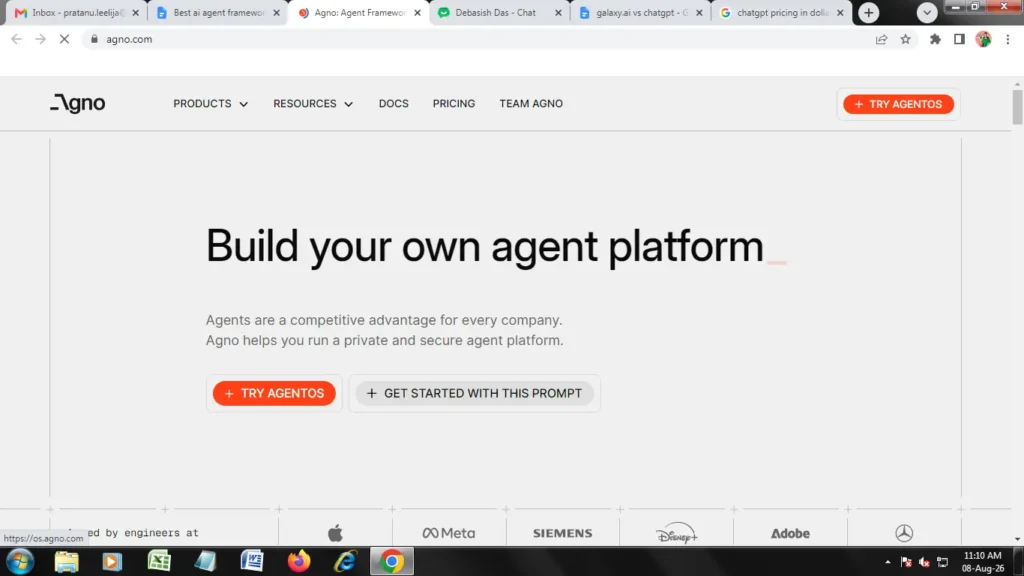
Agno is an open-source and lightweight Python framework for generating, managing, and growing autonomous AI multi-modal agents.
Features
- Connects with primary LLM providers.
- Deals with video, audio, pictures, and text in the form of output and input.
- Keeps a history of session chat and context in the long run.
- Links with agents in vector retrieval.
- Offers native toolsets to the agents for live data.
Pros
- Shows an execution cycle with very low memory.
- Works on several tools at the same time.
- Connects with LLM providers in the absence of ecosystem lock-in.
- Bypasses complicated setups.
- Shows regular database storage for the sessions.
Cons
- Deals with independent agent groups.
- Regular interference loops increase the expenses of the API tokens.
- Needs accuracy in state governance and database for controlling context drift.
- Manual coding is essential for advanced parsing and custom modules.
Pricing
- Free: $0
- Pro: $150 per month
- Enterprise: Contact the sales team.
Best for
Python native technical groups, AI software engineers, and software masterminds.
What’s new in 2026
I have found major improvements in Agno related to the infrastructure of production and Model Context Protocol integrations. Besides, I observed CI/CD evaluation gating, along with the fine-tuning pipelines. I am amazed to see milestones like switching to an Apache 2.0 license along with multi-agent team modes. I found a rise in platform connectivity.