
Do you know how ChatGPT generates responses? ChatGPT creates a response by changing the prompt into tokens, interpreting the situation using a transformer model, predicting the upcoming token, and changing the tokens into text.
Today, you will learn about the application of AI thoroughly, interpret the information and create a summary of reports. You can produce innovative presentations and rectify your mistakes.
This guide shares the simple ways in which you can understand what happens as you press Enter and the answer from ChatGPT appears. No need for any technical qualifications.
Table of Contents
How does ChatGPT generate responses (Step by Step)
In ChatGPT, the process of writing answers is as follows:
Step 1: Adding information and parsing
In ChatGPT, start typing a prompt. The previous messages, present one in chat, and secret instructions are shared with the model as a single input.
Step 2: Tokenization
The text has been divided into tokens, and it includes word pieces, whole words, and punctuation, word pieces. Every token has an ID number, which is converted to a number list or embedding and at last, it gets the right meaning.
Example:
Input:
“ChatGPT is helpful.”
This will be split into tokens roughly like:
“Chat” + “GPT” + “ is” + “ helpful” + “.”
Every token is changed into a number that helps the model to organize.
So, the general flow is:
Text → Tokens → Numerical representations → Model processing → Response
Step 3: Arranging the situation
The tokens go through different layers of the transformer through self-attention. The model finds out which words are most important for one another.
Example:
Rather than writing:
“Write an email about my absence.”
You can organize the situation by offering circumstances:
“I am a student studying in college who missed class yesterday due to sickness. Write a gentle email to the professor telling about the absence and requesting the notes of the missed class.”
So, the roadmap looks like this:
More context about the situation → Proper idea of the appeal→ More pertinent response.
Step 4: Forecasting next-token:
- In the default state, ChatGPT never checks the stored answer.
- It finds out the probability for the next token and selects one of them.
- Certain versions can access the web when their feature is on, and the model selects tokens with controlled randomness.
Step 5: Progressive gathering:
The selected token is used in the passage, and the pattern predicts the upcoming one, which goes on before the stop signal or reaches the limit.
Example:
User:
“I want to write a blog related to AI writing tools.”
ChatGPT:
“Sure. What is your target audience?”
User:
“Beginners.”
ChatGPT:
“Got it. What is your tone?”
User:
“Informative and simple.”
ChatGPT:
“I’ll format the blog targeting beginners through simple language.”
Here is the workflow:
Initial request → Additional information → More context → Refined response.
Step 6: Production and decoding:
The token IDs are changed to words and broadcast on the screen using the safety principles.
Example:
We used a prompt:
“What is the capital of France?”
ChatGPT forecasts internally a pattern of tokens, which creates an answer:
“The” → “capital” → “of” → “France” → “is” → “Paris” → “.”
The model chooses the next token on the basis of the prompt, and tokens are created.
Decoding is a system applied to choose those tokens and build the ultimate response.
Here is the workflow:
Prompt → Model forecasts the next token → Chooses token → Predicts next token → Continues → Final response.
What is The Transformer Architecture in ChatGPT?
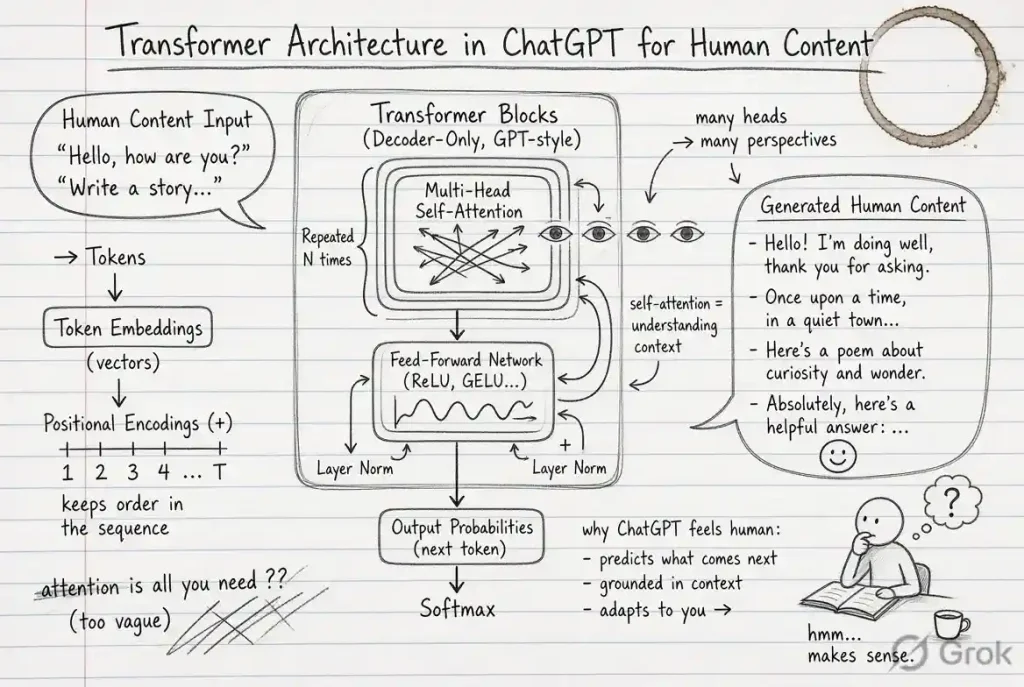
Transformer architecture is a neural network design that allows ChatGPT to follow and generate language. It represents the T in our term “GPT,” which is Generative Pre-Trained Transformer. This is based on a research paper written by a team of researchers published on arXiv on June 12, 2017 written by Vaswani et al. (Attention Is All You Need)
Transformers can compute relationships through self-attention. The model checks the words and offers an attention score demonstrating how pertinent it is for others in each layer, with different attention heads working side-by-side.
Tokens
A token represents some text, generally in English. One token is around 4 characters or ¾ of the word, and AI models follow the text. General words are mapped to one token. If the words are complex, it is broken into some tokens. New models also convert images and audio into tokens before the processing of a model.
Example:
“ChatGPT is useful.”
It will be split into the following:
“Chat” + “GPT” + “ is” + “ useful” + “.”
The genuine tokenization relies on the tokenizer and model. So, the examples are descriptive in comparison to the right representation in each model of ChatGPT.
Does ChatGPT Create Similar Responses?
ChatGPT does not provide the same responses to everyone. But various factors help in creating responses.
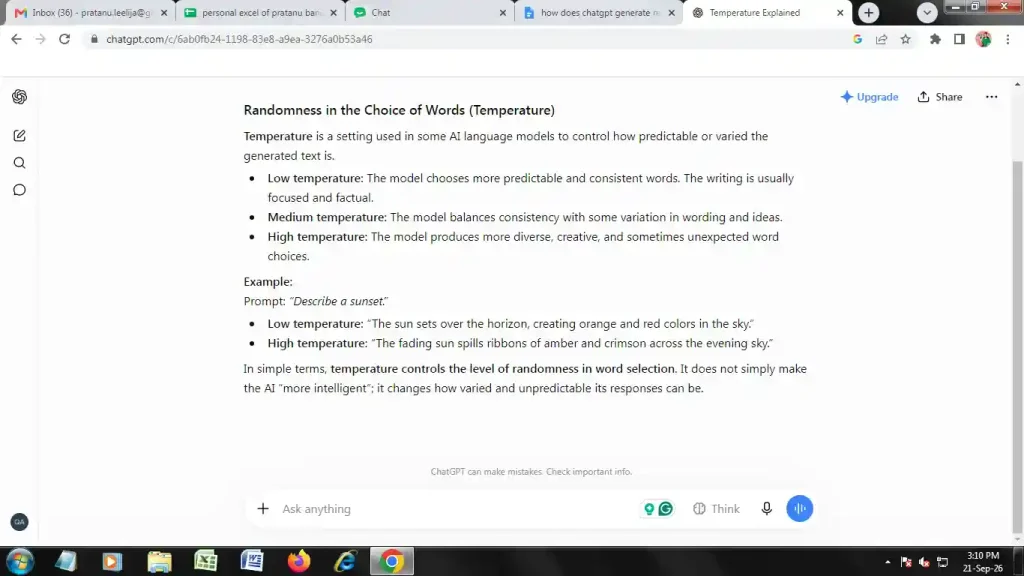
1. Randomness in the choice of words (temperature)
When we searched for this in ChatGPT, we found that there are low temperature, medium temperature and high temperature, along with an example.
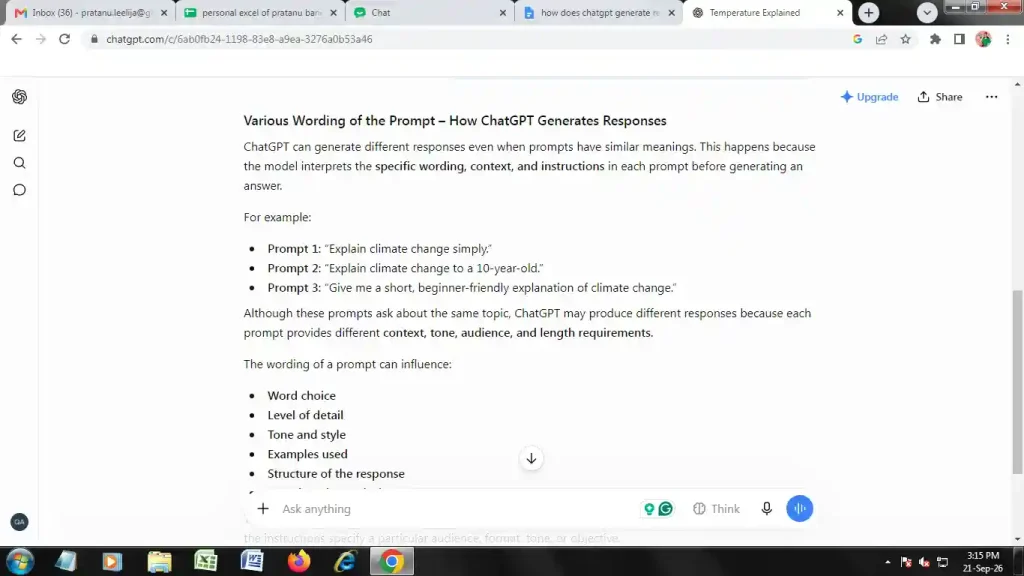
2 . Various wording of the prompt
When we searched for different wording of the prompt with our prompt, we got three examples, where the first example is “Explain climate change simply.” Then the second prompt is “Explain climate change to a 10-year-old.” Then, the third prompt is ” Give me a short, beginner-friendly explanation of climate change.”
The wording in a prompt can affect the length, complexity, structure of response, examples used, tone and style etc.
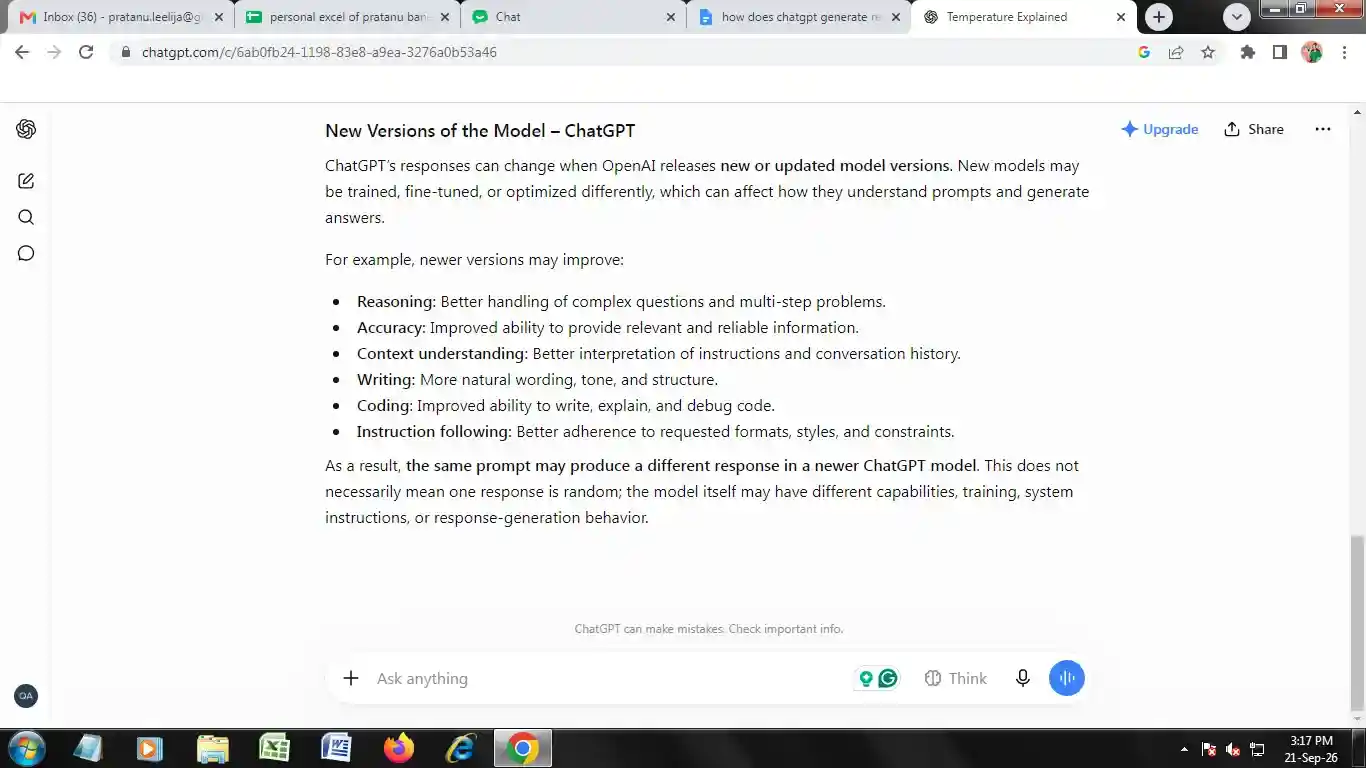
3. New versions of the model
When we talk about the new versions of ChatGPT, we come to know the benefits of the new models e.g., reasoning, accuracy, context understanding, writing, coding and instruction following.
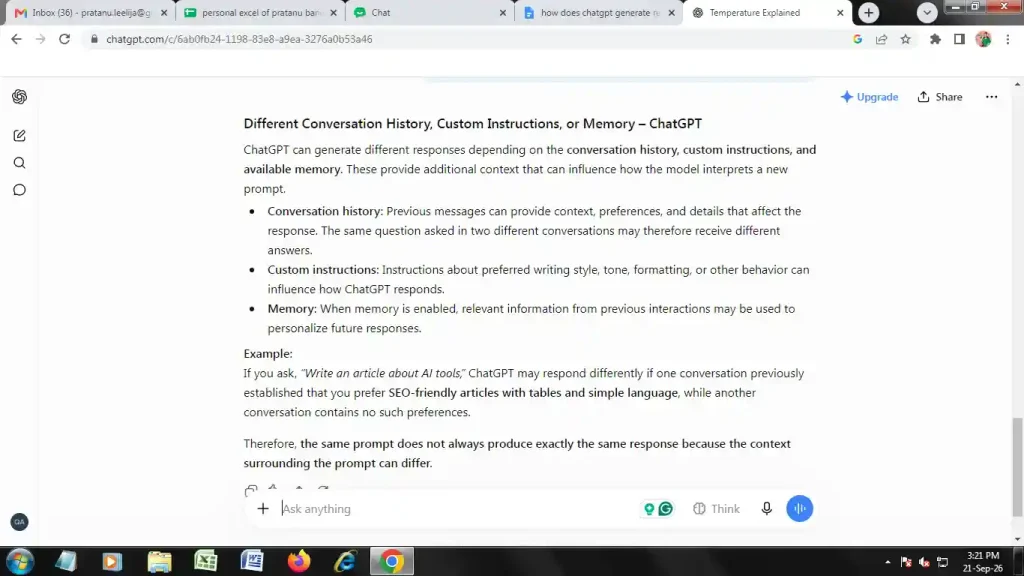
4. Different history of conversation, custom instructions or memory
We have come to know that conversation history influences the preference and context of the previous message. The custom instructions tell us about formatting, tone and nature of writing. Memory enhances the personalization of responses in the future.
Limitations of ChatGPT’s Response Generation
There are several limitations of ChatGPT despite having a strong technological base.
- ChatGPT can hallucinate, as it creates confident but faulty statements because it forecasts some words rather than examining the facts.
- The tool has a knowledge cutoff until the application of web research.
- The AI tool has a context window limit, allowing lengthy conversations to lose the initial details.
- It might show partiality in the training information.
Example 1:
User:
“Who is the writer of the book The Moon Garden published in 1985?”
ChatGPT may give a wrong reply:
“James Anderson is the writer of The Moon Garden and it was published in 1985.”
When the author or book was not present, ChatGPT had hallucinated the data.
Example 2:
Let me share another example of the context window limit of ChatGPT:
User: “Keep the 20 rules in mind I shared with you initially in this long conversation. Now use rule #3 for the new task.”
When the conversation crosses the present context of the model, ChatGPT will not get the initial instructions in the active context.
Example 3:
An example of partiality in training data in ChatGPT has been shared below:
When the user raises a question in ChatGPT:
“How did various nations think about the historical event?”
ChatGPT offers a reply that offers sufficient information or priority to the perspective that is presented in the best possible way, as that particular perspective appeared several times in the training information.
Read more: How To Switch from ChatGPT to Claude.
Conclusion
ChatGPT creates responses by changing the prompt into tokens, applying a transformer to follow the situation, and forecasting one token at a time. The replies become useful as the training on the large text data and human feedback or RLHF generates useful replies. The reason is that it forecasts some words rather than examining the facts and approving the vital information.
FAQ
How does ChatGPT keep context in big communications?
ChatGPT goes through the previous messages in the same conversation via self-attention, up to the context window limit.
Does ChatGPT have the power to deal with confusing queries?
ChatGPT uses context clues to understand the intent, and it might create a clarifying query.
What is the right way of improving the precision of the replies?
Be particular, offer circumstances and instances, share the format you need, and examine the vital facts.