
Do you want to know about AI tools for academic writing? Nowadays, scholars and students apply AI to their writing.
At present, academic writing is more than just grammar correction. The researchers apply AI for reviewing literature and managing citations. In order to find errors in grammar and spelling, these tools are quite suitable. It is suitable for arranging ideas or enhancing the structure of a sentence.
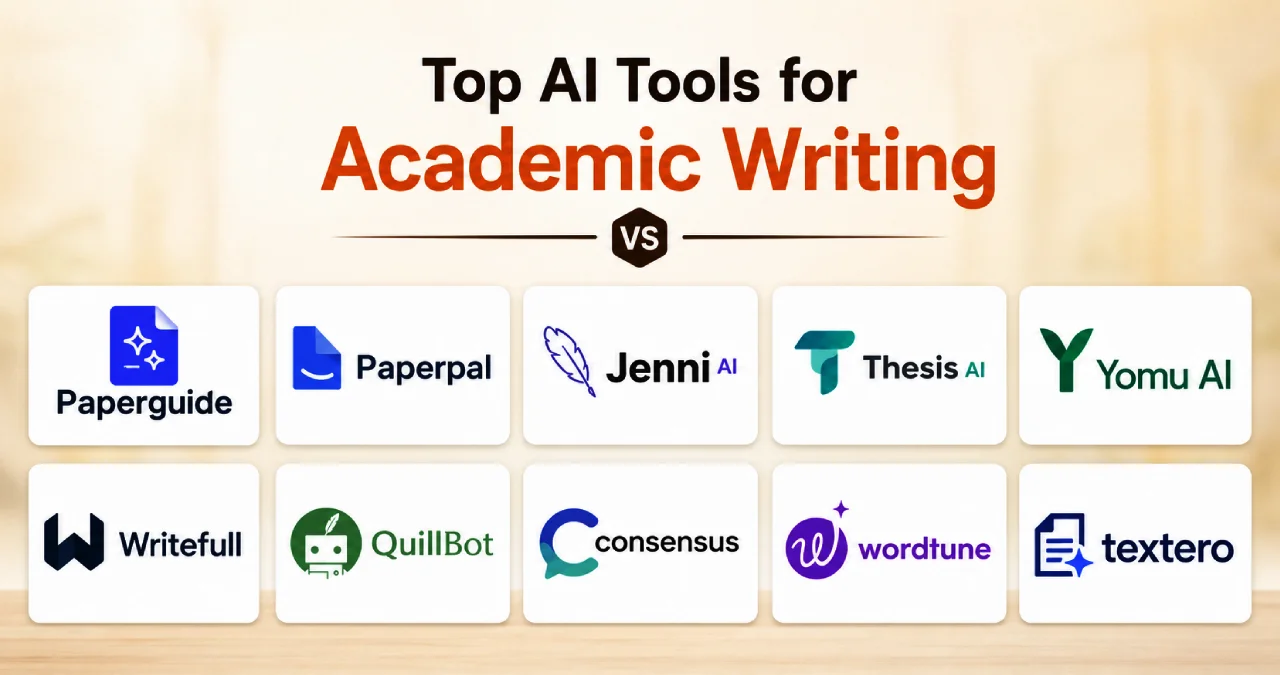
The popular AI tools are Paperguide, Paperpal, Jenni AI, Thesis AI, Yomu AI, Writefull, Quillbot, Consensus, Wordtune, and Textero. It assists in research discovery.
From this Ainewsjournal guide, we’ve checked the top AI tools for academic writing to guide you in selecting the perfect one based on budget and workflow.
Table of Contents
Why are AI tools essential for Academic Writing?
AI tools help with research in different ways, and they are as follows:
- Improve academic style and grammar.
- Create precise citations
- Arrange the references
- Form a summary of the research paper.
- Help with literature reviews
- Find out plagiarism
- Improve clarity and readability
- Save time for conducting research.
- Help the ESL researchers.
How did we evaluate these AI Academic Writing Tools?
We assessed each tool using a similar academic workflow, including reviewing the literature, creating citations, paraphrasing, editing grammar, summarising research, and organising documents. It regulates the standard of AI writing and controls plagiarism, simplicity of use, and total value.
Top 10 AI Tools for Academic Writing
1. Paperguide
PaperGuide AI is a complete research AI tool for scientific and academic papers.
Features
- Acts as an AI writer for a research paper.
- Reviews literature and conducts intensive research.
- Works as an AI reference manager.
- Functions as an extractor of information.
- Communicates with PDF easily after uploading.
Pros
- Holistic workflow.
- Adds citations in the document.
- Permits people to compare research papers.
- Reaches popular models for good reasoning.
Cons
- Tough to learn for a beginner.
- High annual charges.
- Response time is slow.
- It assists in examining the literature.
Pricing
$12 per month (annually)
Best for:
Students, scientists, researchers, and academics.
2. Paperpal
Paperpal represents an AI-assisted academic writing tool created to guide academicians, students, and researchers in editing, drafting, and submitting scholarly posts.
Features
- Helps in live translation.
- Assists in predictive writing.
- Examines the language of the academic field.
- Adds a citation at the time of writing.
- Checks whether the research paper is fit for submission.
Pros
- Translates the research papers.
- Writes accurately..
- Paperpal offers plagiarism detection via premium offers or integrations.
Cons
- Threat of general reply.
- Takes time to understand the platform.
- Costly premium version.
Pricing
$11.58 per month (annually).
Best for
Students, academics, researchers, PubMed, and Semantic Scholar integration.
3. Jenni AI
Jenni AI can be defined as an AI tool working as a research guide and writing assistant, which assists experts, academics, and students in citing and drafting research papers.
Features
- Creates indicators in a sentence and generates ideas for writing.
- Links with the database for precise citations.
- Helps in summarizing research papers.
- Assists in AI editing.
Pros
- User-friendly platform.
- Upload PDFs and talk to them.
- Helps in finishing sentences.
- Links with the database for searching sources.
Cons
- Creates arguments at the surface level.
- Citation needs manual approval.
- Sometimes, content shows the presence of AI.
Pricing
$12 per month (annually)
Best for
Legal writer, technical writer, market researcher, government analyst, and academic writer.
4. ThesisAI
ThesisAI is a platform using generative AI created to improve scholarly writing. It permits people to add a PDF to a structured draft with a complete citation in one prompt.
Features
- Assists in document creation.
- Creates drafts and exports them in different formats.
- Suggests citation.
- Offers AI-guided drafting with citation feedback.
Pros
- Quick drafting of the document.
- Helps in automatic sourcing.
- Integrates the workflow with PDF, Word, etc.
- Offers modifiable settings.
Cons
- Absence of critical thinking in the thesis.
- No intervention at the time of writing.
- Threat of hallucination.
- Absence of authenticity.
Pricing
$14 per month (annually)
Best for
STEM experts, academic researchers, and postgraduate students.
5. Yomu AI
Yomu Ai can be defined as an intelligent workspace for academic writing to guide researchers and students. It helps in formatting research papers, theses, and essays.
Features
- Assists in the creation of tables, headings, images, and others.
- Examine the document to guarantee authenticity.
- Reduce, reword, or create a summary with the editor.
- AI-guided tools assist with writing.
Pros
- Generates new ideas and AI drafting.
- Controls duplicate content.
- Assists with citations in Chicago, MLA, and APA.
- Helps in changing various AI patterns.
- Permits exporting the documents and keeps the formatting.
Cons
- Absence of a free tier.
- Lack of auto-suggestion for citation.
- Robotic style needs editing by a human being.
Pricing
Pro $11 per month (annually)
Best for
Students, academicians, and researchers.
6. Writefull
Writefull indicates an AI-enabled language tool customized particularly for writing in the research and academic field.
Features
- Write a normal sentence in an academic style.
- Offers rectification in grammar and structure.
- Improves the flow of narration through new phrases.
- Creates abstracts, titles, and responds to queries on answers.
Pros
- Writes phrases and technical terms properly.
- Offers language feedback directly.
- Shows features like an academic paraphraser, a title generator, and an abstract generator.
- Helps in the confidentiality of the research paper.
Cons
- The tool is not good for marketing copy and regular emails.
- Limited research management facilities.
- Absence of wide features.
Pricing
- Free: $0
- Premium: $150 per year.
Best for
Academic editor, professor, university student, and researcher.
7. Quillbot
Quillbot is an AI -supported paraphrasing tool created to improve writing and assist people in grammar checking, summarizing, and creating clear content.
Features
- Helps in rewriting sentences.
- Improves the tone from normal to professional.
- Offers plagiarism detection in the Premium version.
Pros
- Anybody can use this platform.
- Helps in the extension of programs like Google Docs and MS Word.
- Assists in summarising and checking plagiarism.
- Regulates the changes of words using AI.
- Presents different styles like formal, creative, fluency, and standard.
Cons
- Some sentences look odd.
- Restricts rewording to 125 words.
- AI detectors flag the paraphrased text.
- Manual editing and cross-examination are necessary in citation.
Pricing
Free: $0
Premium: Starts at $19.95 per month
Best for
Copywriters, marketers, and content creators.
8. Textero
Textero is an AI-guided tool that serves as academic support, designed to help scholars and students generate new ideas.
Features
- Writes thesis and literature review using AI.
- Reaches a wide range of approved academic resources.
- Helps create citations in Chicago, MLA, and APA styles.
- Increases the authenticity and tone of writing.
Pros
- Creates formats and citations in different styles like MLA and APA.
- Uploads customized PDFs for insights.
- Checks the originality of work and safety before submission.
- Forms logical structures and finds new topics.
Cons
- A premium subscription is costly for students.
- Phrases look robotic and need human editing.
- Credit limits of the free version are quite low.
Pricing
$8.25 per month (premium yearly)
Best for
Academics, researchers, students, journalists, and freelance writers.
9. Wordtune
Wordtune is an AI-assisted writing tool that guides people to improve the style of writing and grammatical problems.
Features
- Integrates with different platforms.
- Examines the spelling and grammar.
- Summarizes YouTube video, article, document, and PDF.
- Helps in generating ideas.
- Changes the tone of text to persuasive, professional, or casual.
Pros
- Offers different types of sentences.
- Modifies the tone of writing, e.g., empathetic, persuasive, casual, and formal.
- Checks the context of sentences while rewriting.
- Shortens big articles and documents.
Cons
- Lack of personal tone in writing.
- Causes an error in technical writing.
- A premium subscription is costly for general users.
Pricing
- Basic $0
- Advanced: $6.99 every month, and the billing is made annually.
Best for
Non-native English speakers, students, researchers, editors, content writers, social media managers, marketers, and managers.
10. Consensus
Consensus indicates an AI-enabled academic search engine created for exploring a large number of peer-reviewed papers.
Features
- Offers automation of complex reviews in literature.
- Interprets the search results in the top 20 for creating a visual barometer.
- Works as an analytical and research tool.
- Saves papers into collections and exports bibliographies.
Pros
- Explores a wide range of scientific papers.
- Researchers can check the references.
- Find answers based on the reference.
Cons
- Features are restricted in the premium version.
- The usage is restricted in the free state.
- The subscription is quite costly.
Pricing
- Free: $0
- Pro: $10 per month
Best for
Product managers, analysts, journalists, science and healthcare experts, students, and academicians.
| Disclaimer: Pricing and features might change over time. Kindly check the official website for further details. |
Comparison of 10 AI Tools for Academic Writing
| Tool | Basic Academic Focus | Basic Strength | Best for | Free plan | Citation | Plagiarism | AI writing | Research finding |
| Paperguide | Platform for research and writing. | Approved citation. | Thesis writing and reviews of literature. | Limited Free Plan | Yes | Limited | Definitely | Present |
| Paperpal | Improves grammar and language. | Discipline-related rectification. | Researchers devoted to English writing. | Yes | Assisted | Available | Present | Limited. |
| Jenni AI | Paragraph-level creation. | Easy insertion of citations. | Creating a section in research papers. | Yes | Yes | No | Correct | Limited |
| Thesis AI | Initial draft creation | Creates complete chapters. | Quick formatting for big documents. | Absent | Yes | Absent | Yes | Limited |
| Yomu AI | Clean writing workspace. | Visual citation manager | Writing short essays | Limited | Present | Limited | Present | Yes |
| Writefull | Improve style for scientific writing. | Uses MS Word and the Overleaf plug-in. | STEM researchers. | Yes | No | No | No | Absent |
| Quillbot | Academic vocabulary assistance | Citation generator and plagiarism checker | Writers and students. | Present | Yes | Absent | Present | No. |
| Consensus | AI search engine. | Discovers facts among peer-reviewed papers. | Creates arguments using consensus. | Yes | Export only | No | No | Present |
| Wordtune | Adjusts the tone and increases clarity. | Enriches the vocabulary. | Improves the basic sentence. | Yes | No | Present | No | Absent |
| Textero | Idea generation tool | Summarises text and creates an outline. | Formats the structure of the essay. | Limited | Yes | Present | Yes | Available |
Can AI Replace Human Academic Writing?
| Feature | Human Academic Writing | AI Academic Writing |
| Analysis | Strong involvement with proof, understanding several aspects. | Generates content based on existing training data. |
| Authenticity | Creates new theories, ideas, and private feedback. | Adds patterns from present training information. |
| Style | Different lengths of sentences for a particular field. | Formal and based on a formula. |
| Accuracy | Depends on the basic investigation. | Threat of hallucinated information. |
| Context | Suits the cultural influence and course needs. | Absence of intense awareness of the situation. |
Competitor Positioning and Messaging of Leading AI Academic Writing Tools
AI academic writing tools concentrate on a particular targeted workflow. Rather than working as a generic writer, popular websites position themselves in the form of accurate scholarly use cases. The major players in the sector differentiate by unique messaging. It varies from the in-line drafting in autocomplete form to the top-quality improvement in language and a holistic review of literature.
| Tool | Positioning | Messaging |
| Paperpal | Language editing | Complete manuscripts for publishing. |
| Paperguide | Research workplace | AI research copilot. |
| Jenni AI | Writing Assistant | Writing through citation. |
| Consensus | Evidence search | Scientific answers |
Future of AI tools in Academic Writing
The academic writing has a bright future, and it depends on the right combination of machine efficiency and human intellect. AI is used to overcome the problems in writing and improve the manuscripts.
On the other hand, the fundamental analysis and genuine voice should be completely human. The scholars using the above tools should have a sound knowledge to improve the standard of research.
- AI agents: AI agents have been changing academic writing by changing from ordinary chatbots to cooperative assistants for investigation.
- Research copilots: It concentrates on the independent exploration of literature, structural outlining, automatic synthesis, and editing based on context.
- RAG: Retrieval-Augmented Generation, or RAG, is changing scholarly writing by linking large language models or LLMs to the current database of researchers in comparison to the frozen training information.
- Multi-document analysis: They are tools which increase the process of work and need human approval to stop errors and keep the research on the right track.
- Semantic search: It is a change from static text creation to a semantic research guide.
- Reference automation: AI is basically transforming the handling of references in scholarly writing by shifting from stationary databases to ever-changing, context-related assistants.
- Emerging AI assistants: NotebookLM shows the main change in academic writing through a particular source-based thinking assistant. Google Gemini has been changing the future of scholarly writing by changing from a fundamental text generator to an agentic research partner.
Conclusion
AI tools for academic writing are strong tools for creating drafts and research. These tools improve the feedback in literature, argumentative writing, and prose. The popular AI tools are Paperguide, Paperpal, Jenni AI, Thesis AI, Yomu AI, Writefull, Quillbot, Consensus, Wordtune, and Textero. It functions as a smart assistant for researchers and students. To improve the academic standard, the scholars implement critical thinking and approve the production. Finally, they must maintain the quality of ethical writing.
FAQ
Which AI tool is best for academic writing?
Among the above AI tools for academic writing, Paperguide is really great. Writefull or Paperpal enhances the language. Consensus is a search engine for research.
Can AI tools help detect plagiarism in research papers?
Yes, the AI tools are great for finding duplication in the research papers. But we need to know that a plagiarism checker discovers duplicate content. On the other hand, the AI detectors examine whether the content is created using any bot.
Are AI tools useful for literature review?
Yes, AI tools seem to be perfect for the review of literature. It reduces the time of research, summarizing, and mapping the academic sources.
Can ChatGPT write academic papers?
Yes, ChatGPT has the power to create academic papers at the technical level. Several universities permit AI-guided drafting, but putting AI-assisted work without any kind of disclosure may go against the policies of the academic field.
Is AI allowed in universities?
The universities permit the use of AI. But the guidelines for application differ among professors and institutes.
Which AI tool gives citations?
Consensus helps find studies and export citations.
Which AI tool is free?
Writefull, Quillbot, Wordtune, and Consensus are free AI tools.
Which AI tool is best for thesis writing?
ThesisAI and Textero are the two tools for writing a thesis.
Which AI tool supports APA?
Yomu AI and Textero support APA formatting.