
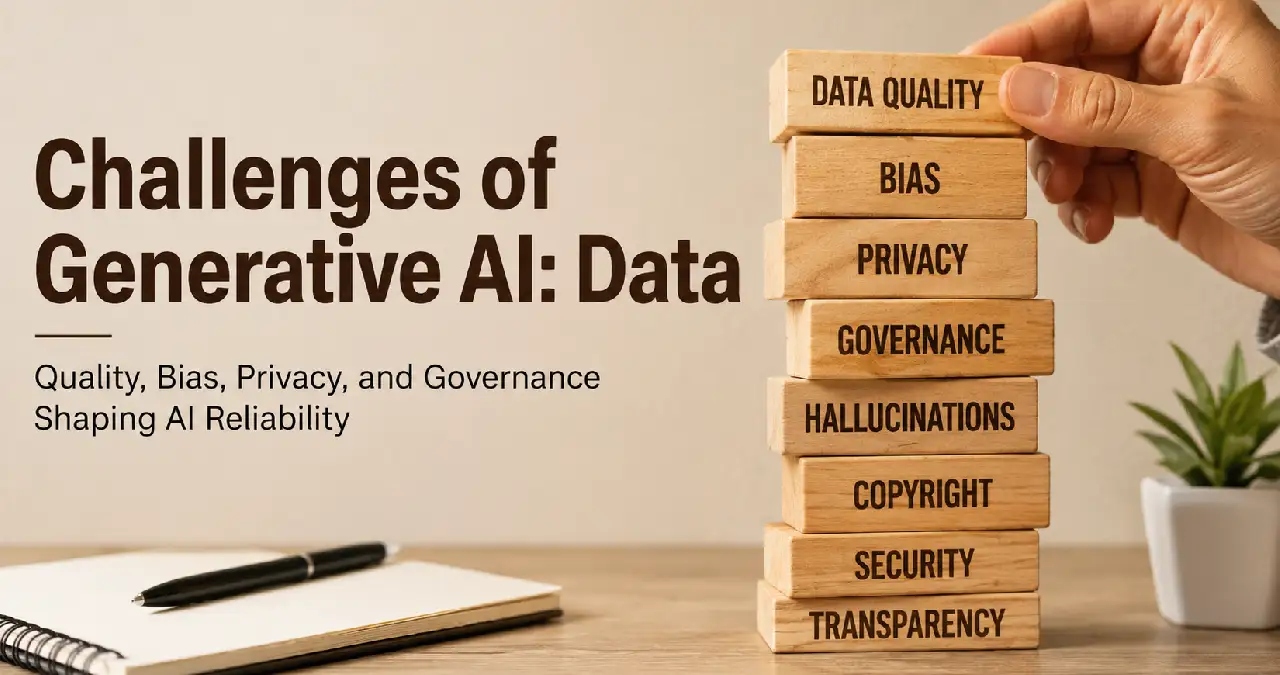

Do you want to know what challenges does Generative AI face with respect to data?
Generative AI relies on the high quality of training information. However, problems like low data quality on AI, poor copyrighted datasets, privacy issues, bias, copyright issues, and AI hallucinations can decrease the level of precision and dependability of AI-generated content. It faces problems due to the exposure of intellectual property. The generative AI data challenges are important for improving precision, transparency, ethics, and legal aspects of AI systems.
In this Ainewsjournal article, I am going to discuss the problems of generative AI related to data.
Table of Contents
Why Data is Important in Generative AI
Data is essential in generative AI for the following reasons:
- Identifying patterns and training: AI gets the training from different datasets. The training helps in understanding the variation in language.
- Precision and standard of output: It depends on AI-generated content, which is linked to the standard of data.
- Connection and circumstance: Adjusting the AI in particular sectors needs domain-related data.
- Reducing bias and security: The models learn biases present in their training data.
Major Data Challenges in Generative AI
Data Availability: Generative AI needs a lot of datasets. Besides, the performance declines due to restricted data.
Data labelling: High-standard labelling enhances the precision of the model.
Fresh information: New AI needs recent data. When the AI datasets are outdated, it creates
Hallucinations: AI hallucinations happen as the model creates fabricated data, which is quite convincing, but there is no training data to support it or fact-based sources.
Data Governance: The data governance includes the ownership, monitoring, agreement, and auditing.
Synthetic Data quality: Training datasets contain errors, unrelated data, and incorrect information. Low-quality training information in an AI model is responsible for creating false or wrong outputs. Several developers associated with AI are frequently applying synthetic datasets to add to the genuine data, but low standards in the synthetic data will decrease the output of the model.
Multilingual data: There are several languages that possess low datasets, and this creates a lot of problems.
Security Threats: The datasets for training possess malicious or poisoned data. It is called a Data Poisoning Attack.
Representation and bias: Training data often shows social and historical biases. Sometimes it overrepresents certain populations. In reality, the models show the same type, and they may produce unfair or discriminatory output.
Secrecy and Agreement: Private data are part of these datasets. Training datasets consist of copyrighted material without any definite licensing. Besides, it may decrease the reliability of AI results. It causes legal threats, and GDPR fines are one of them. Finally, it might reveal sensitive information.
Scalability and Infrastructure requirements: Big datasets need significant computational resources, along with storage to organise. In reality, technical hurdles and huge expenses restrict the creator from training basic models.
Licensing and data provenance: It is the source and the right of application in data training that is unclear or without official reports. In real life, it forms a legal irregularity related to the violation of copyright.
So, we have mentioned what challenges generative AI faces with respect to data.
For further guidance, you can visit the OECD AI Principles.
How Data Quality and Bias Affect Generative AI
The different biases are as follows:
Separation: In the hiring system, biased AI is a major problem for some candidates related to ethnicity or gender.
Reinforcement of social biases: The models of generative AI will implement fatal stereotypes.
Impact on AI reliability: As the AI processes create wrong outcomes, the public’s faith might be lost in the institution and technology.
For the latest AI discoveries, visit Google DeepMind.
Real World Example of Bias in Generative AI
- Based on the academic report of Cornell University published on arXiv.org as “Bias in Generative AI”, where Mi Zhou et al (March 5, 2024) interpreted more than 8000 images.
- They are AI-supported, such as DALL · E 2, Stable Diffusion, and Midjourney, showing that Generative AI could create biased representations across different professions.
- Standard prompts are used, like ‘portrait of [occupation]’, where the investigators discovered regularity in gender and bias in race in three tools.
- For instance, the percentage of females in different images of occupation was quite low in the genuine benchmarks.
- 42% in Dall-E-2, 23% in MidJourney, and 35% in Stable Diffusion.
This study shows that the bias is present regularly in various models of generative AI. It gives priority to the requirements of different datasets, continuous monitoring, and fairness testing for AI development.
How to Reduce Data-Related Challenges in Generative AI
1. Improve Data Quality: To decrease bias in generative AI, the basic practice involves producing and dealing with different types of representative training datasets. ChatGPT might produce false legal tips when they are taught on old-fashioned legal information.
2. Increase Dataset Diversity: It consists of acquiring data from different materials.
3. Remove sensitive data: It is important to delete sensitive information.
4. Data governance: It applies data minimisation and uses live lineage tracking.
5. Continuous audits: Regular auditing of generative AI outputs is essential for discovering bias, which is not found at the initial stage.
6. Human review: It sets up a strong data foundation and connects a tough human-in-the-loop review system.
How does low-quality data cause AI hallucinations?
Hallucinations happen due to the following reasons:
- Lack of knowledge: As there is insufficient knowledge, it may cause AI hallucinations.
- Probabilistic prediction: Certain forecasting is based on probabilities.
- Confusing prompts: Sometimes the user creates prompts that are quite confusing.
- Absence of context: At certain times, the context is absent, which might create an AI hallucination.
- Inconsistency in information: Certain data shows a lack of consistency. :
Data Governance and Compliance
The governance and compliance of data in Generative AI is based on the following:
- GDPR: Generative AI causes a lot of disputes in the General Data Protection Regulation, as it relies on removing big datasets, such as adding private information. It follows the principles, e.g., data minimization and tough rules related to an automatic decision-making system.
- CCPA: The California Consumer Privacy Act, or CCPA, is used straightaway in generative AI. The firms and AI developers using generative models should have tough regulations on the way of scraping, training, and the use of private information in production.
- Consent: Consent in generative AI indicates the legal and ethical need to get the perfect right from people prior to using, scraping, or teaching AI models on private information or innovative outputs.
- Licensing: The licensing in Generative AI includes two types of legal structures: Input Licensing, where the training of AI models takes place over data under copyright, and Output Licensing, where the owner or content monetization is assisted through AI.
- Ownership: Ownership of the assets is under significant debate. The reason is that the AI models could not have intellectual property in a legal way. The enterprises should be accountable for their AI production, along with the contracts with the vendor.
Future Data Challenges in Generative AI
The challenges of generative AI in the future are as follows:
- Synthetic data: As the AI models teach the AI-assisted data, they face a declining learning loop called “model collapse”. The models do not remember rare occasions and hallucinate several times.
- AI-generated datasets: When the basic seed data has errors, the synthetic data is going to increase inequalities.
- Deepfakes: Face-swapping and AI voice cloning are used for crimes like extortion, AI voice cloning along with financial scams.
- Regulation: Jurisdictions are charging adamant windows takedown. For instance, the websites face the threat of legal action when they do not provide guidance, and their goal is to delete illegal synthetic content quickly.
Conclusion
Finally, a major problem in developing Generative AI could be the structure of the algorithm.
If you want to know what challenges does Generative AI face with respect to data, they are quality, privacy, copyright, governance, fairness, and hallucination. AI productions may not have depth, nuance, or accuracy related to the domain. It needs a lot of human editing to achieve accuracy.
In privacy, there are training models over huge datasets removed from the internet which grabs personally identifiable information. In terms of copyright, the AI tools use images, code, or text under copyright for training, and they do not attribute the original writer. It has led to several lawsuits related to responsible AI.
In governance, the nature of the neural networks is quite tough for companies to audit, as the steps are taken. In fairness, the AI models become the owners and increase the biases of human beings from the training information, creating culturally insensitive production. In Hallucination, the large language models show a probabilistic nature as they forecast the upcoming word and avoid checking factual information.
FAQ
What is the responsibility of data privacy in generative AI?
Data privacy tells us the way secret, private data is kept, acquired, and used with the help of ethical AI. It finds out that the systems show faith in the user’s permission and save intellectual property.
How to solve data bias in an AI system?
The main strategies to solve the data bias are different types of training information, preprocessing and auditing of data, and setting up teams in different fields. In addition, it involves the infrastructure of bias detection and applies a human-in-the-loop system for major steps in AI.
Why is copyright challenging for Generative AI?
Generative AI basically challenges the copyright law as it works on a particular scale. It works in a way legal framework is not created. It interprets a large number of works in the absence of human understanding and creates new posts in a fraction of a second.