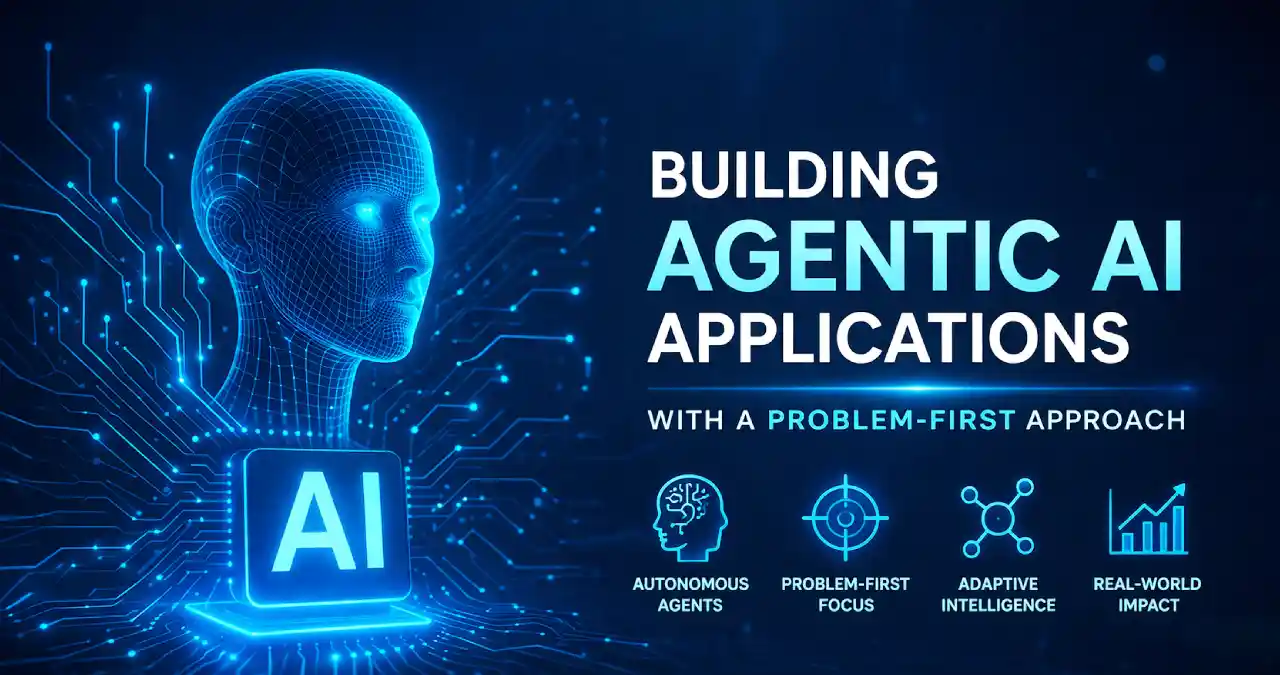

In the last few years, models have driven AI growth. It concentrates on quick and big processes. But in 2026, companies are transforming agentic AI applications through a problem-first approach.
Rather than beginning with models, the groups start by pointing out the difficulties of any business, limitations and workflows based on the final step. It can work independently and be modified easily. It can adjust the results constantly
Table of Contents
What is Agentic AI?
Agentic AI refers to systems that can operate independently toward a defined goal. Unlike traditional AI that responds to prompts, agentic systems can plan, reason, act, and learn from outcomes. These AI agents add the feeling, logic and executive power to control complicated tasks in several steps with the least human intervention.
Core Capabilities of Agentic AI Development
Agentic AI development has the following features:
- Independent decisions: The workers can organize in their own way and take action.
- Live data processing: It interprets live data constantly.
- Task execution: It can create the workflow in a dynamic way.
- Incorporation of system: Links with CRMs, APIs,
Agentic AI Needs Strong Infrastructure and Governance
Old-fashioned software depends on simple regulation. Besides, it deals with errors manually. On the other hand, the agentic AI always changes. It absorbs the information and engages with the visitors.
It has a unique idea about agentic systems’ genuine importance. It matches the right ways of leadership.
What is a Problem-First Approach in Agentic AI?
The problem-first method in Agentic AI points out the failure in business. It forms a map of the human strategy of resolutions. It explains autonomy and talks about safety.
It creates an AI agent within the limits. You will find a direct connection between AI effort and business results in technology.
Step-by-Step Guide in Building Agentic AI Applications
The planning of Agentic AI links with technical design and operations.
Step 1: Explain the issue of the business
It points out the different problems in a business. It finds out the issues of technical operations and designs.
Step 2: Map decision workflows
It creates a map of the workflow based on decisions.
Step 3: Point out the sources of data
It finds out the origin of data through research.
Step 4: Design agent loop
This involves perception, reasoning, action and finally feedback. LLMs, RAG(Retrieval-Augmented Generation) and memory systems are present.
Step 5: Select the framework
It chooses the right framework. The examples are LangGraph, AutoGen and CrewAI.
Step 6: Install and observe
It installs the application successfully and observes its performance.
Agentic AI: Exploring The Basic Levels
The levels are perception, reasoning, action and feedback. Let us talk about their goal along with an example.
| Level | Goal | Example |
| Perception | Get signals from systems and users. | IoT sensors, CRM data and Logs |
| Reasoning | Assess the alternatives and take steps. | Rule engines and LLMs |
| Action | Carry out tasks through connection. | API calls and tickets. |
| Feedback | Understand from the results. | Observing the performance. |
Process of creating Autonomous AI Systems
You will find groups who want to build AI agents from scratch. Initially, the projects are small.
You will get a clear idea about the problem with one source of information.
The agent works on a single process. In this position, the capacities increase slowly, and it helps in reducing the technical burden. It enhances our reliance on the future.
Comparison of The Best AI Agent Framework in 2026
The choice of the best AI agent architecture depends on connection, visibility and independence. These are the best frameworks for building agentic AI applications.
| Framework | Suitable for | Positive Side |
| LangGraph | Instrumentation of workflow | Agent regulation in several steps |
| AutoGen | Joint effort of several agents | Organizing activities on communication. |
| CrewAI | Joint effort of several agent systems | Workflow related to responsibility. |
| Semantic Kernel | Business process | Connection with Microsoft environment. |
The architecture gets service from the framework. On the other hand, the framework does not explain it. With problem-first AI design, you will find a change in the framework of the workflow.
Agentic Chatbots work as Personal AI Agents
Most of the companies begin the project using agentic chatbots. Other than the normal bots, the systems have the power to collect information using internal tools. It starts the workflows and adjusts with the replies on the basis of circumstances and previous communication.
Real-Life Examples of Agentic AI in Business
| Industry | Use Case | Result |
| SaaS | Automatic agents for onboarding. | Decrease in assistance for workload. There is a rise in engagement of 30%, with a rise of 40% claim processing. |
| Healthcare | Agents for planning | Increase in patients. The market will increase by 45.56% CAGR by 2030. |
| Finance | Agreement checking experts | Quick audits. About 2.3x return is guaranteed using Agentic AI applications under 13 months. |
| Manufacturing | Repairing experts | Decrease in interruptions. It enhances the operation by 20 to 30% by decreasing the idle time and quick decision cycles. |
Top Agentic AI companies changing The Business
Some of the top Agentic AI companies are Microsoft, OpenAI and Adept AI. In Microsoft, there is a combination of Copilot and the semantic kernel. In OpenAI, GPT-based agent frameworks are available. In Adept, action-based AI agents are present.
What is The Right Time for Investment in Custom AI Agents
The importance of customized AI agents increases in the following situations:
- Workflow increases in several systems.
- Circumstance is important in the decision and not instructions.
- Automation is necessary other than the scripts.
- Auditability and compliance are important.
- Return on investment (ROI) for most businesses is 1 to 2 years, and their projects are related to automation.
- In Cost vs benefit, ROI in AI may be beyond instant financial gains. It includes a rise in output, speed, and decision-making. It also consists of customer feedback.
Agentic AI Architecture
Memory Layer
It guarantees continuation, stopping the agent from becoming irrelevant.
Tool Layer
It links with the agent in real life using a database, SaaS tools, code interpreters and APIs.
Reasoning Engine
It simplifies complicated targets to manageable sub-tasks.
Tools and Tech Stack in Agentic AI Applications
Agentic AI applications show different tools and tech stack like Langchain, Vector DB, APIs and Observability tools.
- LangChain: This includes a basic toolbox offering different parts, e.g. templates with prompts and document loaders. It has pre-built integrations also.
- LangGraph: It offers a map for complicated agents through workflow modelling in the form of graphs in a directed form.
- Vector DB (Pinecone, Weaviate) VectorDB includes Pinecone and Weaviate. Vector Database works in the form of agents for a long-term database.
- Pinecone: This is a vector database in a cloud-native state and managed completely.
- Weaviate: This is a vector database of open-source, which includes graph-based connections and vector search.
- APIs: They are tools permitting agents to carry out activities like web search and code execution.
- Observability tools: Due to the non-linear nature of agentic workflows, it is tough to debug in an old-fashioned way.
- Langsmith: It is the perfect website for observing, testing and debugging.
Measuring Units to Calculate Success in Agentic AI Applications
- Task success rate: This is a basic metric calculating the percentage of activities an agent finishes independently in the absence of a human being.
- Latency: It is the performance which includes end-to-end latency and step latency.
- Cost per decision: This is the efficiency, which talks about the token consumption and cost per task.
- Accuracy: It presents the quality metrics where you will find the tool use accuracy, reasoning quality and hallucination rate.
Challenges and Risks of Agentic AI
Challenges of Agentic AI are as follows:
- Hallucinations: It involves failure in the operation and memory errors.
- Security threat: It consists of attacks in the supply chain, data exfiltration, agent hijacking, etc.
- Overautonomy: It involves shadow AI, misalignment of the target, lack of control over autonomy, etc.
- Compliance: It consists of regulatory differences, confusion in accountability, and bias amplification.
- Monitoring tools: You will find observability gaps, nondeterministic behaviour, cost metrics and high latency.
- Guardrails: They discover anomalies at the early stage, stopping activities from independent AI agents.
- Human-in-the-loop-systems: It causes operational expenditure, latency and bottlenecks. It goes against the target of autonomous pace.
Best Practices for Problem-First Agentic AI
- Begin with business issues and avoid tools
For using Agentic AI, you have to start with the problems of a business. Then, you need to bypass the different tools.
- Explain the target and limitations
You can talk about the target in agentic AI. The user can also share the limitations.
- Take the help of structured data to decrease hallucinations
In order to prevent hallucination in an agentic AI application, you need to use structured information.
- Apply the architecture of a hierarchical agent
For a hierarchical agent, you have to use the architecture in the right way.
- Retain Sub-agents in a stateless way
For the agentic AI, you have to hold the sub-agents as a displaced entity.
- Use checklists on human beings for major workflow
In the agentic AI, you can take the help of checklists on human beings for improving the workflow.
Conclusion
Building agentic AI applications with a problem-first approach involves something beyond chasing frameworks. It consists of solving genuine problems in a business with the right independent processes. Companies are matching AI for their decision-based workflows. It also includes governance with calculated results. It is going to create the upcoming revolution in creativity in 2026 and in the future.
FAQ
What is agentic AI testing, and how is it performed?
Agentic AI testing examines the nature of independent processes in real-life situations. It concentrates on regularity and dealing with drawbacks. It points out the bias and limitations in the security.
How is an agentic AI strategy different from traditional automation?
Agentic AI planning gives priority to taking decisions along with adaptive workflow in comparison to the general scripts. The traditional automation obeys the instruction. On the other hand, agentic systems modify the activities on the basis of response, situation and new situations.
What does agentic mean in artificial intelligence systems?
In AI, agentic can be defined as the power of a process to work independently for a target. Agentic systems study the circumstances and then take the right step. It takes action and gains experience from the results.
What is the cost of building agentic AI?
Agentic AI development cost is $50000 for the systems. In the case of complex enterprise services, it is more than $1 million.
What is the difference between AI agents vs chatbots?
AI agents work freely to reach a particular target, while chatbots carry on waiting for the feedback of the user and reply under the guidelines. Agents have the power to talk through external tools, while Chatbots have read-only communication and offer data.