
AI knowledge management tools change the way companies deal with knowledge discovery by substituting passive storage of files with intelligent and active systems. The challenges include remote work and information overload. The borderless teams face the problem of knowledge fragmentation.
The unstructured data increases the enterprise data volume. The solutions are RAG and AI-supported search. At present, the enterprise search engine links with the applications in the digital workplace, like Notion, Teams, Slice, etc. RAG architecture connects the difference between proprietary company information and large language models.
The outcome is active knowledge capture and a knowledge gap. Developed systems create knowledge graphs in the company. AI algorithms point out the lack of data or questions without answers in the workflow.
In this Ainewsjournal article, I will talk about intelligent document management.
What are AI Knowledge Management Tools?
There is significant development of the technology stack. At present, the solutions use transformer-based language models to capture significant semantic knowledge. The knowledge graphs are used to create a map of the relationships between ideas.
There are retrieval-augmented generation (RAG) architectures, which ground AI responses in approved organisational information. The technical development converts into benefits, which decrease the time spent searching for data.
These tools are creating automatic repetitive activities and increasing the onboarding of employees. It restores the expertise of the institution. The group members change between roles or abandon the organization.
Table of Contents
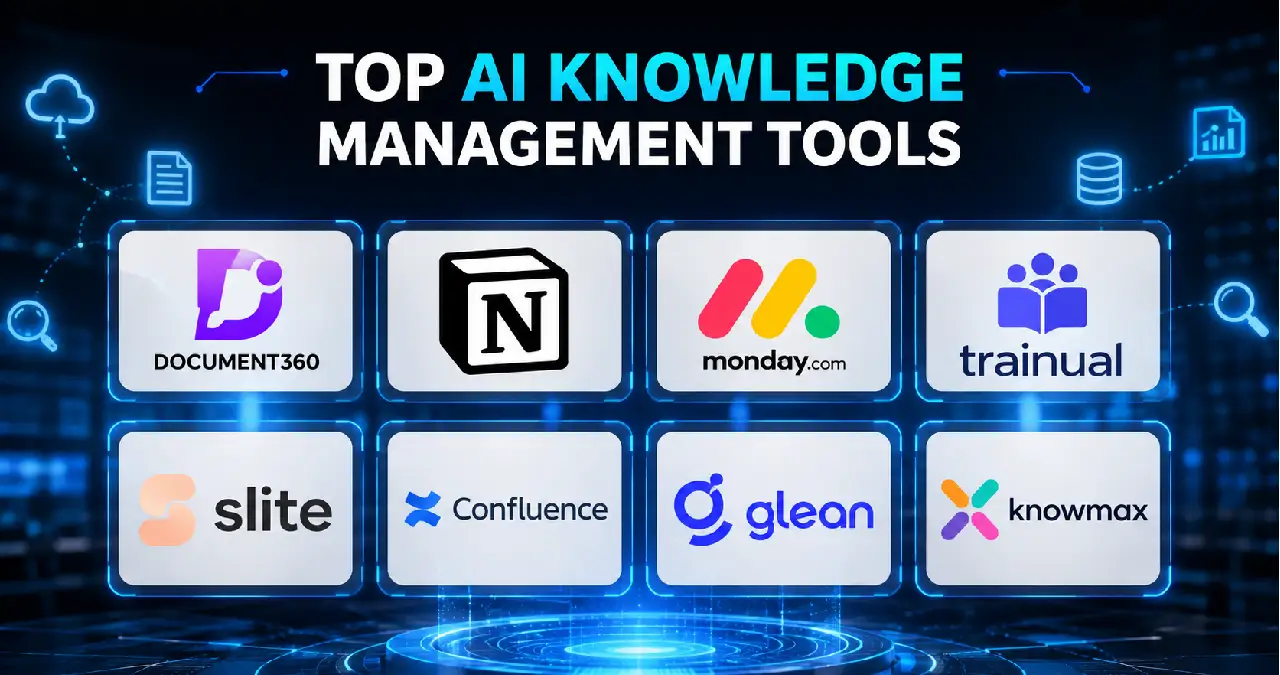
Guide to AI Knowledge Management Tools in 2026
1. Document360
Document360 presents the AI-supported knowledge Base SaaS website. It permits companies to produce, handle and post websites for self-service, API documentation and user manuals.
Features
- High-quality content and AI creation.
- Joint effort for workflows and revision.
- Presents analytics and branded portals.
- Complete control over the access.
Pros
- UI and a user-friendly editor.
- Strict control over content.
- AI-supported skills.
- Presents permissions on the basis of role.
Cons
- Costly plans for new business owners,
- Restricted integration.
- It stops whiteboard or online collaboration.
Pricing
- Free: $0
- Startup: $99 per month
Best for
Content editors, workflow management, and AI chatbot.
Why We Recommend It
For companies dealing with big volumes of technical documents, Document360’s AI-guided search and content control skills are the right choice.
2. Notion AI
Notion AI can be defined as an AI workplace assistant in the Notion workspace, which assists in generating ideas, writing, creating a summary and task automation.
Features
- Helps in workflow automation.
- Acts as AI agents.
- Supports content creation.
- Manages the database.
Pros
- Smooth integration of workflow
- Automatic management of the database.
- Modified AI agents.
Cons
- Costly for single or general users.
- Absence of depth.
- Needs a planned workspace.
Pricing
- Free: $0
- Plus: $10 per month
- Business: $20 per month
Best for
Database Automation, knowledge base software Q&A, custom agents, and inline writing.
Why we recommend it
Notion AI is highly recommended for context-aware replies, in-line editing, quick summary, and automation of the database.
3. Monday.com
Monday.com can be defined as a cloud-based visual work OS and website for handling projects. It assists the groups in observing and planning marketing campaigns and activities.
Features
- Drag-and-drop modifiable boards.
- Strong automation in the workflow.
- Several views in the project, like Gantt and Kanban.
- Live reporting dashboard.
- AI-guided activity.
Pros
- Efficient automation.
- Remarkable visual interface.
- Integration.
- Modifiable to a great extent.
Cons
- Expensive for groups.
- Regular tools are quite costly.
- Time-consuming to learn.
Pricing
- Free: $0
- Basic: $9 per seat per month
- Standard: $12 seat per month
- Pro: $19 seat per month
Best for
Product development, CRM, sales and project management.
Why we recommend it
The top reasons behind referring to it are intuitive interface, strong automation of workflow, specialization, native integration, and AI -supported tools.
4. Trainual
Trainual can be defined as a website for employee onboarding and AI-powered knowledge management created to work as a digital playbook for businesses.
Features
- Offers teaching and recruitment.
- Works as a centre for tools and software.
- Helps in high-level reporting.
- Links with regular tools like Google Calendar and Zapier.
Pros
- Tracking of development in training.
- Arranges the training materials in an online location.
- AI-guided drafting.
- Organizes policies and tests for locations.
Cons
- Costly for small businesses with limited budgets.
- Fails to create advanced analytics.
- Absence of a mobile application.
Pricing
- Small: $299 per month
- Medium: $349 per month
- Growth: $499 per month
Best for
Agencies, startups and remote teams.
Why we recommend it
Trainual saves time during onboarding, role-related learning, accountability, AI-supported content creation, and mobile access.
5. Slite
Slite indicates an AI-guided knowledge base suitable for distributed teams and remote groups. It helps in documentation, internal wikis and data of companies.
Features
- Works as an AI search.
- Looks through connected tools like Slack automatically.
- Identifies backdated data.
- Links with more than 20 tools for data.
- Easy migration.
Pros
- Improved and user-friendly interface.
- Intelligent AI search.
- Perfect for decision-making and shared writing.
Cons
- Absence of original tools for database management.
- Restricted modification.
- Wide application is limited in the free plan.
Pricing
- Basic $10 per user per month
- Pro $20 per user per month
Best for
Onboarding of employees, self-regulated knowledge base, and communication.
Why we recommend it
The reasons are the onboarding of employees, absence of clutter, approval of knowledge, smooth collaborative work and excellent integration with other tools.
6. Confluence
Confluence indicates a group of AI tools created to improve team activity and improve enterprise knowledge management.
Features
- Creates a complete draft of documents.
- Helps in natural language search.
- Creates modified AI agents for generating ideas.
- Changes normal text to infographic, chart and presentation.
Pros
- Quick summary of big documents.
- Instant creation of content.
- Natural language search
- Automatic workflow.
Cons
- Problem with permission and security.
- Needs advanced plans.
- Lacks accuracy.
Pricing
- Free: $0
- Standard: $5.42 per user /month
- Premium: $10.44 per user per month
Best for
Knowledge management, reporting, exporting and diagramming.
Why we recommend it
Confluence AI is good at quick content creation, quick summary and understanding, sophisticated workflows and AI agents.
7. Glean
Glean indicates an AI-supported work platform and enterprise search. It links with the application of the firm internally for mapping information of organization and indexing data.
Features
- Finds results in more than 100 applications on one search bar.
- Offers content creation.
- Demands work-associated queries in natural language.
- Presents templates and agent sandboxes.
- Approves the activities of agents.
Pros
- Decreases the changing of context.
- Permits groups to create customized AI agents without code.
- Indexing of the company’s data.
- Links with more than 100 enterprise apps.
Cons
- Depends on the standard of data.
- High price of enterprise.
- Needs governance and setup.
Pricing
- Basic: $295 per month
- Pro: Custom
Best for
Software and engineering situation, workflow of AI agent, and workplace AI help.
Why we recommend it
Glean is recommended for agentic workflows, personalized AI, enterprise-grade security, and accelerated onboarding.
8. Knowmax
Knowmax indicates an AI -supported knowledge management and a website for helping the agents to improve the customer experience and enhance the activities at the contact center.
Features
- Offers feedback and analytics.
- Creates examinations and quizzes automatically.
- Helps with non-technical issues.
- Produces systematic workflows.
Pros
- Assists support workers systematically.
- Removes information silos through the creation of content.
- Links with the main websites of the helpdesk and CRM.
- User-friendly platform.
Cons
- Restricted customization.
- Absence of assistance on fundamental subjects.
- Takes some time to understand.
Pricing
$14.99 per month
Best for
Content creation using generative AI, omnichannel assistance, interactive decision trees, etc.
Why we recommend it
Knowmax is recommended for multilingual assistance, security, quick onboarding, and AI-guided content creation.
How to Choose The Right AI Management Tool
The important ways to select the right tools are as follows:
1. AI Search Quality: An important aspect is whether the members can naturally raise questions.
2. Integration Support: The AI tools can integrate with Slack, Teams, Google Drive, SharePoint, Salesforce, and CRM systems.
3. Security: It is important to check whether the AI tools have SOC 2, GDPR, and ISO 27001.
4. Scalability: It depends on the size of the team, storage, and indexing capacity.
5. Cost: It relies on per-user, per-workspace, and enterprise licensing.
Genuine Business Influence over AI Knowledge Management Tools
- Increases the retrieval time and reduces search to a great extent.
- Improves output.
- Decrease in support expenses.
- Improved decision-making.
- Decrease in loss of knowledge.
- Quick onboarding
AI Knowledge Management Tools: Instant Comparison
| Tool | Core focus | Main AI feature | Approximate pricing |
| Document360 | Technical documentation and the centre for customer care. | Agent for AI writing, context-conscious chatbot, quick auto-translation. | Quote related or sales oriented. |
| Notion AI | Proactive agents and automation. | Autonomous Ai agent. | Free $0, Plus $10 per month |
| Monday.com | Management of workflow and holistic projects. | AI ticket triage and dynamic auto-response. | Begins at $12 per seat per month with AI credits. |
| Trainual | SOP training and employee onboarding | Translation, grammar detection. | Begins at $61 per month |
| Slite | Internal knowledge and remote team wikis. | Request AI for a quick response. | Standard: $8 per user per month, and Premium: $20 per user per month |
| Confluence | Technical group platform and engineering wikis. | Quick content summary and automatic writing. | Free and standard starts at $6.05 per user per month. |
| Glean | Enterprise-related federated search and AI help | Links more than 100 apps for semantic search. | Begins at $50 per user per month. |
| Knowmax | Contact center assistance and customer care | Writing an AI decision tree and sending proactive knowledge. | Subscription-related. |
Why do AI Knowledge management tools fail?
The reasons behind the failure of AI knowledge management are as follows:
- Adding junk information and getting useless data.
- Absence of running governance.
- Excessive reliance on irregular format.
- Absence of contextual appreciation.
General Use Cases of AI Knowledge Management Tools
The use cases of the AI tools are as follows:
- Customer Care: The clients can get a quick response.
- Employee Onboarding: It trains employees within a short span of time.
- IT Documentation: It has centralized knowledge.
- Remote Teams: The tools are perfect for sharing information.
- Compliance: It helps in managing the policy.
What creates AI Knowledge Management Tool Different from Conventional Knowledge Bases?
| Feature | Conventional Knowledge Bases | AI Knowledge Management Tools |
| Semantic Search | Matching with the exact keywords | Follows the circumstance and user intent. |
| Natural language querying | Needs strong Boolean operators. | Admits conversational language. |
| AI assistants | Manual browsing is essential. | Offers summaries and proactive assistance. |
| Auto tagging | Depends on the entry of manual metadata. | Automatic classification of content within a short time. |
| Knowledge Graphs | Presence of siloed and isolated articles. | Links associated ideas in documents. |
| RAG-assisted answers. | Shared a cluster of links | Creates new and direct answers. |
Conclusion
AI knowledge management tools use knowledge graphs to determine the relationship between concepts. The popular AI tools are Document360, Notion AI, Monday.com, Trainual, Slite, Confluence, Glean and Knowmax. They improve the time of retrieval and reduce the absence of knowledge. It regulates the content automatically and changes to an agentic system. The main reasons behind the failure are adding extra data, lack of governance, dependency on irregular format and lack of contextual appreciation. To select the right AI tool for knowledge management, we have to check the requirements of the firm, examine the AI-related features,
FAQ
How do AI knowledge management tools work?
AI knowledge management tools work through data ingestion, intelligent processing, automated organization, and semantic search.
What are the best AI knowledge management tools in 2026?
The popular tools for AI knowledge management are Document360, Notion AI, Monday.com, Trainual, Slite, Confluence, etc.
How do AI knowledge management tools help the customer support team?
AI tools for knowledge management help decrease support tickets, increase personal service, enhance onboarding, and allow human agents to concentrate on complicated problems.
Are AI knowledge management tools secure for enterprises?
The tools for AI knowledge management are good for enterprises. They are built using tough layers of governance and security guidelines in the enterprise.
What do you mean by semantic search in knowledge management?
Semantic search indicates a sophisticated data retrieval technique, which interprets the situation, meaning and intent of the user.
What is the role of RAG in AI-generated responses?
RAG acquires pertinent facts from an outside database prior to creating a response.
Which is the right AI knowledge management tool for enterprises?
Glean is ideal for context-aware response, and Confluence is perfect for companies using Bitbucket or Jira. Notion is ideal for developing startups.