

Are you facing a traffic drop on your website? The brand may not be visible in AI-supported answers, and AI systems never rank pages statically. So, how can an AI search-monitoring platform improve an SEO strategy?
We have found a market shift from conventional SEO to GEO. Conversational queries get more importance than fragmented keywords. When the informational visitors fall, then the visitors in AI search have a strong intention to buy and naturally convert from AI overviews.
You will understand the importance of this SEO strategy as it offers live visibility and restores the popularity of the company. One can find those competitors in AI platforms like ChatGPT and Gemini.
The solution involves using AI monitoring platforms with a group of AI tracking tools and improving the direct answers in zero-click searches. It gives priority to authenticity and E-E-A-T and applies schema markup to mention connections among web pages.
In this Ainewsjournal article, I will talk about how AI search monitoring websites can improve SEO strategy.
What is an AI Search monitoring Platform?
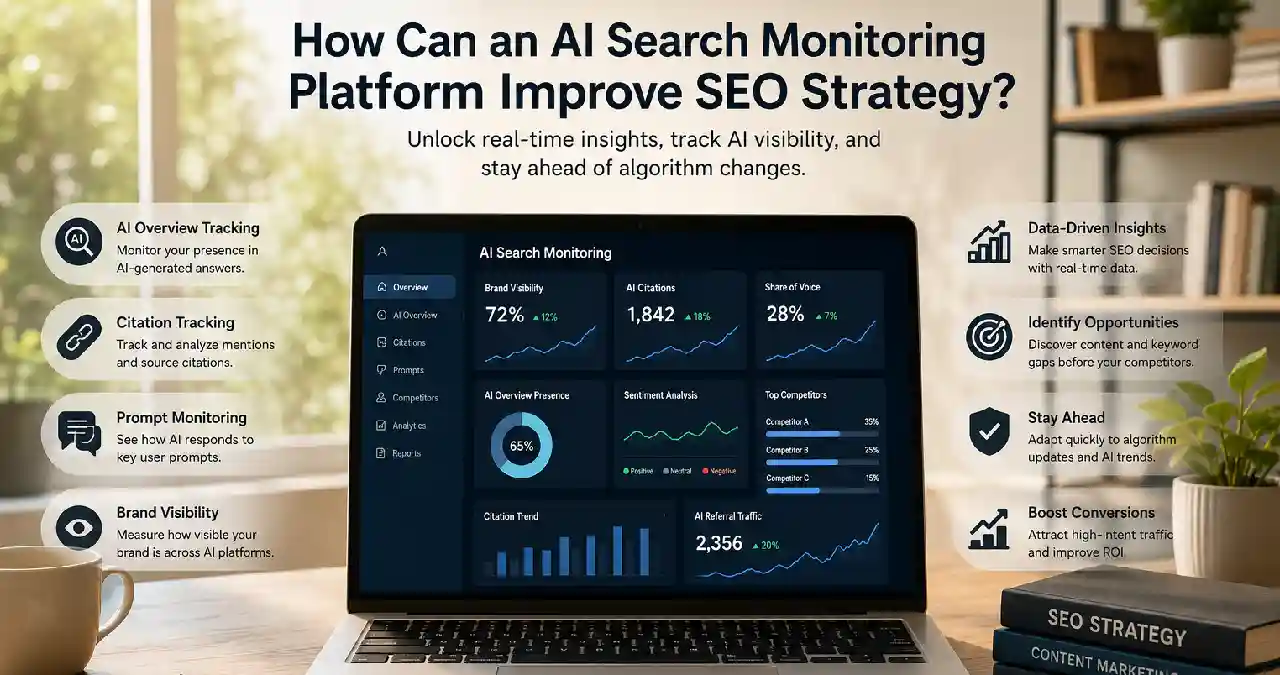
An AI search monitoring platform represents a software system that observes how a topic, product, or brand is present in AI-supported chatbots and search engines. It includes AI overviews, tracking, citation tracking, prompt monitoring, share of voice, and brand visibility.
- AI overviews tracking: It checks the results in AI overviews.
- Citation tracking: It examines the citation of the company in AI overviews.
- Prompt monitoring: It checks the behavior of the prompt in the AI search results.
- Brand visibility: It establishes the presence of the brand in the search results.
The purpose of an AI search monitoring platform is to offer insights at the prompt level, conduct sentiment analysis, and perform competitive benchmarking.
Rank tracking tools are different from AI search monitoring platforms in the following ways:
- Rank tracking tools observe the rank of a keyword, while AI search monitoring platforms’ main target is generative engine optimization.
- The output type of rank tracking tools is numerical position, while the output type of AI search monitoring platforms includes sentiment, brand mention and citation frequency.
Key Metrics Tracked by AI Search Monitoring Platforms
The six ways to track an AI search monitoring platform are as follows:
- AI analytics and referral traffic: Checks the true visitors and click-throughs in the citations of the AI engine.
- Analysis of hallucination and sentiment: Observes the circumstances of the discussion of the brand using AI.
- Visibility in the prompt level: Checks the user prompt and unique search queries.
- Share of voice of competitor: Observes the frequency of citation of competitors in comparison to the brand in unique search queries.
- Source tracking and citation: It points out whether AI can mention the particular URL.
- Entity tracking and brand mention: The website observes that the brand gets mentioned by the LLMs.
- Rate of appearance in AI Overview: It indicates the number of times a brand appears in AI Overview.
- Trend in citation frequency: It shows the trend in citation frequency of the brand.
- Source authority score: It reveals the authority score of the source.
- AI referral traffic: It indicates the visitors coming from the AI referral.
Why Does Conventional SEO Monitoring Fail?
The reason behind the failure of conventional SEO monitoring is as follows:
- Change to zero-click: Half of the Google searches are completed without any clicks, like Direct Answers and AI Overviews.
- Development of Generative AI: Observing exact-match keywords misses the citation of brands.
- False metrics: The rise in organic impressions does not show income.
- Distorted reality in the technical world: The problem of sight speed is actually the lack of internal control.
- Reduction of clicks in AI Overviews: We have to get source citations and aim at bottom-funnel keywords.
- LLM answer engines bypass SERPs: Brief questions and answers, and assist the AI crawlers with statistics and data.
- Traditional rank trackers ignore citations: Improve the citation trackers and GEO, and improve the entity-first indexing.
How to Solve The Problem of SEO Monitoring?
The way to solve the issue of SEO monitoring is as follows:
- Observe the genuine KPIs: Change attention from search engine rank to business metrics.
- Watch the AI citation: Take the help of a new website to check the share of voice.
- Conduct daily audits: Solve the internal structural silos and guarantee the condition of the website.
- Study the AI Overviews: It is essential to check the AI overviews.
- Interpret the entity presence: We need to examine the availability of the entity.
- Monitor competitor mentions: One must watch the mentions of the competitor.
- Associate AI visibility and conversions: The expert should check the conversions and AI visibility.
What are the problems of measuring AI Search Visibility?
The problems of measuring AI search visibility are as follows:
- Several AI platforms: There are different platforms like ChatGPT, Google AI overview, Gemini, etc.
- Various models of citation: The citations have different models, which create problems in AI search visibility.
- Changing answers: Every time, the answers of AI search visibility keep changing.
- Modified responses: The responses are customized to fulfil the needs of the person.
The Benefits of an AI Search Monitoring Platform
For an AI search monitoring platform, the benefits are as follows:
- Maintaining the popularity and brand: Observes the biased reactions to stop rising PR threats.
- Tracking the citation: Points out the reviews and pages of AI platforms for citation.
- Recommendation of the competitors: Calculates the frequency of referral of the brand versus the rivals.
- Gap analysis based on action: Points out unique queries where the rivals are referred to, but your company is absent.
- Rebound of conversion and visitors: Links the criteria of downstream business and AI answers without clicking, indicating referrals that were not mentioned before.
- Perception of brand and citation tracking: AI offers direct answers without any clicks.
- Conversational intent analysis: The user can check the exact prompt and questions in the LLMs.
- Identifying irregularity and live algorithm: AI monitoring identifies the fall in visibility quickly.
- Improvement of E-E-A-T and content: The tools interpret the real reason behind the selection of the site.
- Quick content optimization: The content is improved within a short span of time.
- Initial identification of loss in ranking: The loss in rank can be pointed out at the initial stage.
- Proper discovery of the content gap: It helps in pointing out the gap in content.
- Increases topical authority: It develops knowledge on a particular topic.
- Improves the rate of AI Overview inclusion: It enhances the chance of being seen in the AI overview.
For further information, visit why use AI search optimization tools for your business.
5 Techniques for Developing an SEO Strategy Using AI Search Monitoring
The popular ways of forming an SEO strategy using AI are as follows:
- Check the AI citations: AI citations help us create the right strategy in SEO.
- Explore the gaps in content: The gap in content will enhance the SEO strategy.
- Observe the change in the algorithm: The shift in the algorithm will assist in creating the SEO plan.
- Watch your competitors: For AI search monitoring, study the rivals carefully.
- Measures AI referral traffic: SEO strategy improves when we calculate the AI referral traffic.
General Errors in AI Search Monitoring
People commit five mistakes in AI search monitoring, and we need to avoid them in the following way:
- Depending only on rankings in the keyword, AI search monitoring fails when we depend on keyword rank only.
- Avoid checking the AI citation: It fails when we bypass the examination of the AI citation.
- Observing Google only: AI search monitoring fails when we check only one search engine, like Google.
- Failure to link with business results and visibility: AI search monitoring does not take place when we cannot connect visibility and business outcomes.
5 Popular Functions of AI Search Monitoring Platforms
The functions of AI search monitoring platforms are as follows:
- Prompt tracking: AI search monitoring websites track the prompts.
- Citation collection: It creates a list of citations.
- Competitor comparison: An AI platform for search monitoring compares the rivals.
- AI visibility analysis: AI search monitoring interprets the AI visibility.
- Dashboards for reports: AI search monitoring has dashboards for reporting to users.
Top 7 Features to Learn in an AI Search Monitoring Platform
AI search monitoring platform offers a wide range of features, and they are as follows:
- Checking AI Overview: AI search monitoring platforms check the AI overview carefully.
- Observing ChatGPT: ChatGPT is studied with the help of AI search monitoring platform.
- Monitoring Perplexity: With the help of an AI search monitoring platform, we can monitor Perplexity.
- Interpreting the competitor: AI search monitoring platform conducts the best analysis of the rival.
- Citation tracking: AI search monitoring website tracks citations accurately.
- Sentiment monitoring: Studying the sentiment is another vital feature of an AI search monitoring website.
- Reporting: AI search monitoring platform has the power to generate informative reports.
5 Unique Use Cases for SEO Teams
SEO teams offer a wide range of use cases, and they are as follows:
SaaS SEO
In SaaS SEO, the AI search monitoring platform finds a solution for Generative Engine Optimization. The platforms transform the target from conventional rankings of keywords to changing the frequency of referral of software, framed, cited through LLMs, e.g., Perplexity, ChatGPT, and Google AI Overviews
Enterprise SEO
The Enterprise SEO use case includes generative engine optimization, sentiment and brand monitoring, citation gap analysis, predictive market intelligence, risk management and compliance.
Agency SEO
The use cases of agency SEO are share of voice and citation tracking, sentiment and brand monitoring, content gap analysis of competitors, prompt engineering, GEO auditing, and automated white-label reporting.
E-commerce SEO
The use case of E-commerce SEO includes competitive benchmarking, conversion analytics, AI traffic, AI -guided conversational content, structured data auditing, product schema, consensus analysis from different sources, and generative engine optimization.
Local SEO
Analyzing local SEO for AI search monitoring websites consists of improving and tracking the business in the generative search outcomes on different websites like Perplexity, Gemini, Google AI overviews, and ChatGPT.
Conclusion
AI search monitoring platform changed SEO completely to a data-supported science. You have come to know how can an AI search monitoring platform improve SEO strategy. You came to know the different ways of AI search monitoring. The reason behind the failure of AI search monitoring has been explored. We have understood the advantage of AI search monitoring. There is a discussion on the different ways of forming an AI SEO strategy. Finally, a discussion has been made on the solution to mistakes in AI search monitoring.
FAQ
How AI SEO is different from conventional SEO?
Conventional SEO helps in ranking on the first page to get clicks. On the other hand, AI SEO improves content to get cited by AI tools.
How does an AI search monitoring platform observe AI citations?
AI search monitoring platform can mention the content, and they send a message when the competitor beats the company.
Do AI Overviews decrease the organic visitors in a stable ranking?
Yes, AI-supported answers can guide the intention of the user in the absence of a click.