
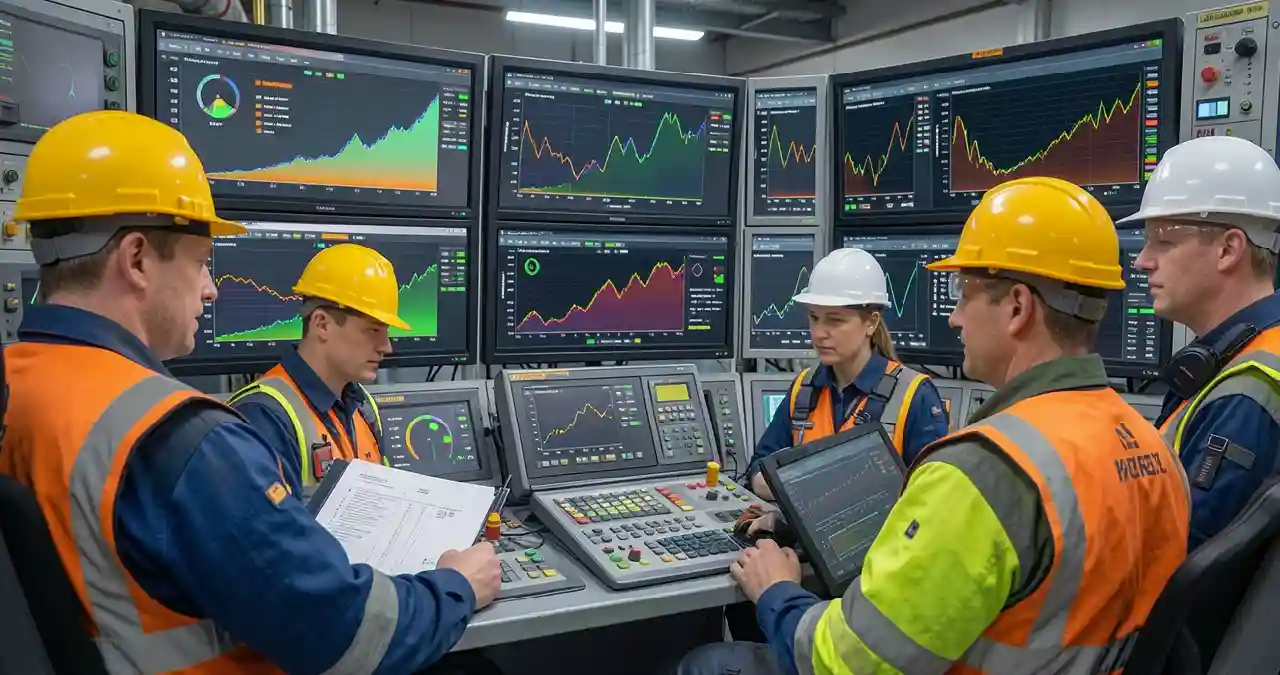

SCADA systems generate massive industrial data, but turning that data into actionable insights has always been a challenge. In this situation, you will get a combination of generative AI, modern analytics and machine learning in SCADA. Rather than substituting operators, it reduces noise and predicts potential failures in advance and converts raw tags into the right steps.
In this Ainewsjournal article, you will discover how AI has been integrated into SCADA.
Table of Contents
What is SCADA?
SCADA is Supervisory Control and Data Acquisition, which is the architecture of a control system for observing and handling an industrial system.
Components: It handles different geographic areas of industrial processes for the remote terminal units, programmable logic controllers and human-machine interfaces. The communications networks and centralized SCADA servers are available.
Limitation: SCADA systems in old-fashioned form depend on alerts at a threshold and logic using rules. The AI presents messages and predictions. It offers referrals, CMMS and alarm lists. There are dashboards and HMI screens.
Why AI is Needed in SCADA Systems
Industrial control systems present important target areas. It is meant for cyber attacks.
- Data overload: It points out the dangers of online by setting up operational criteria like command sequence, function code and network traffic.
- Alarm fatigue: The operators have a lot of non-actionable alerts.
- Lack of predictive capability: It is reactive and rule-based with limited storage and data processing.
How AI Has Been Integrated into SCADA Architecture
There are three levels of architecture in SCADA, and they are Cloud, Gateway and Edge.
- Edge AI
Edge AI presents the patterns of machine learning in industrial gateways, PLCs or RTUs straight away. It is a method supporting anomaly identification for low-latency. It decreases the consumption of bandwidth. It supports operational strength in offline mode. It offers predictive repair at the local level.
- Fog or Middleware Level
There is SCADA telemetry in middleware websites. For the AI intake, there is preprocessing. MQTT Brokers and OPC UA connectors are present in the layers. You can also get a time-series database and a flowing data pipeline.
- Cloud AI
Cloud environments provide scalable computing power for training AI models. It trains big models for the historical information of SCADA. The general forms of integration are the exporting of information from the historian working for SCADA.
It includes feature engineering and preprocessing. The cloud AI websites offer model teaching. The model position is in the central or edge system. There is a connection between the power of interpretation and live response.
The data flow includes a unified namespace and edge computing. The connectivity protocols are open platform communications unified architecture, and message queuing telemetry transport.
Key Use Cases of AI in SCADA
- Management of the power grid: AI predicts load requirements. It identifies the problems in the transformer. Finally, it improves grid stability.
- Arrangement for purifying water: The structure of machine learning modifies chemical dosing. There are two factors, which are variations in the flow and turbidity in the live state.
- Manufacturing: The application of predictive analytics in production to reduce downtime. It creates an equilibrium in the work pressure.
- Energy optimization: It includes compressor optimization, peak shaving, load management, industrial process optimization, and renewable energy management.
- Predictive maintenance: This includes early anomaly detection and smart scheduling. It also includes root cause analysis and a Remaining Useful Life forecast.
- Fault detection: This consists of automated fault localization, intelligent arm handling and virtual inspection.
Key Benefits of AI-Integrated SCADA Systems
- Predictive repair: In SCADA, a common AI application is predictive repair. The machine learning patterns interpret the trends of the sensor.
- Trends: The major trends are pressure, temperature, electrical current and vibration.
- Prediction: AI models predict Remaining Useful Life (RUL) and estimate failure probability.
- Algorithms: The popular algorithms are gradient boosting and random forest. In addition, there are isolation forests and long short-term memory.
- Reduction in downtime: AI significantly reduces operational downtime and response time.
- Quick decision-making: One can make decisions within a short span of time.
- Improved safety: You will find a high level of security in SCADA using AI.
- Historical control information: AI-supported improvement interprets historical control information. It refers to developed setpoints. Some examples are a fall in energy intake and the improvement in production throughput.
- Accuracy of chemical dose: You can control the accuracy of the chemical dose.
- Reinforcement learning: You can apply reinforcement learning in the industries of advanced systems.
How AI Functions in SCADA
The method of application has a particular structure. It needs a dependable connection. The system of integration is as follows:
- Data collection: You need to acquire the data properly.
- Preprocessing: You must process systematically.
- Model training: It is essential to train the models.
- Prediction: You have to forecast it methodically.
- Action: Finally, you need to take the right step.
AI Technologies Applied in SCADA
The technologies used in SCADA are as follows:
Machine learning: Machine learning can be defined as a part of artificial intelligence concentrating on algorithms for understanding training data.
Deep learning: Deep learning indicates a method of artificial intelligence for processing data from the motivation of the human brain.
NLP: NLP is the way of assisting computers to analyze, follow, and create human language.
Computer vision: Computer vision is a branch of artificial intelligence for helping machines in analysis and following visual data from videos and images.
Challenges of AI Integration
AI integration in SCADA must be able to solve some problems, like the issue with data quality, matching with the legacy system, and the high cost of implementation.
- Data quality: AI faces the problem of data quality, and they need to improve it in the future.
- Legacy system: Another problem is its compatibility with the legacy system. There must be a solution to this problem.
- Cost: The cost of applying AI integration is quite high, and we have to control it.
- Security: There are problems in the operation and the absence of trust in AI-based decisions.
Real Industry Case Studies of AI Integration into SCADA
- Plants for water treatment: It is present in Cuxhaven, Germany, for treating wastewater. At Thames Water, there is a chemical dosage reduction. There is less consumption of energy by 20 to 50%.
- Smart grids: It modifies and predicts energy along with renewable integration. There is fault detection.
- Oil and gas predictive maintenance: It comprises offshore rig optimization, pump and pressure dependability. The cost of maintenance has gone down by 12%, and there is a decline in downtime by 25%.
- Reputed companies: Different companies have developed technology in a new way. The popular companies are Mitsubishi Electric, Schneider Electric and Siemens AG. They are top companies presenting a holistic profile on automation. Besides, they have sound knowledge of SCADA.
How AI improves KPIs in SCADA
- MTTR: It is the mean time to repair or which is a major performance metric.
- MTBF: This is the mean time between failures. It is a metric for dependability and maintenance.
- Downtime: This is the time when a machine is inactive.
- Energy Consumption: This is the total energy utilized by systems, organizations or individuals.
Comparison: Traditional vs AI SCADA
| Features | Traditional SCADA | AI SCADA |
| Logic | The rule is fixed. | The learning is adaptive. |
| Response | Reactive using alarms | Predictive using alerts. |
| Decision making | Depends on human beings | Assisted or autonomous |
| Data usage | Monitoring is simple. | Complex analysis of the pattern. |
| Scalability | Manual or low | Automated or high |
| Initial cost | Lower | Higher |
Case Study of Companies of AI Integration into SCADA
The new AI experts are ABB, Honeywell, and Rockwell Automation, offering high-level machine learning. You will discover unique integration websites from Beckhoff Automation and AVEVA Software. The circumstance demonstrates a match between AI creators and old-fashioned leaders on automation.
Future Trends of AI Integration with SCADA
The future of AI integration with SCADA is as follows:
- Generative AI in SCADA: The generative AI consists of natural language interaction, context-aware analysis and data imputation.
- AI – assisted Digital Twins: AI-supported digital twins present different virtual models with high fidelity, predictive maintenance and cyber-physical security.
- Autonomous control systems: Autonomous control systems offer edge AI integration, self-healing systems, and smart adaptive automation.
Conclusion
It might be a customized one. If you want to select one AI skill, which one will you choose? Alarm flood reduction, predictive maintenance, anomaly detection, energy optimization, and Gen-AI shift handover summaries are some of them. Your present industry might be Oil & gas, manufacturing, water or power. You need to know which one is the top problem of SCADA. I will definitely reply with a customized integration method. Finally, you have an idea about how AI has been integrated into SCADA. The AI models rely on datasets, and it is free from confusion. The researchers saw that the information on SCADA has missing values, sensor drift, and there is an irregular sampling rate. The developers should apply strong pipelines for preprocessing them.
FAQ
How is AI integrated into existing SCADA systems?
AI has combined edge computing, cloud platform or middleware layers. It organizes the data of the chronicler of SCADA.
Can AI replace traditional PLC-based control in SCALA?
No. Artificial intelligence supports PLC logic. But there is no substitute for control loops of deterministic form. Based on the principle, there are safety activities. It is also inevitable.
What programming languages are used for AI in SCADA?
For developing a model, you can use Python. You can apply embedded frameworks and C++ for placing inference engines across the edge.
Is AI integration secure in industrial environments?
Yes, the application of coded data channels, AI-supported cybersecurity vigilance and network division.
What industries benefit most from AI-integrated SCADA?
Industries are choosing AI-integrated SCADA systems gradually to enhance speed and operational dependability. It is present in areas like transport, speed in areas like transport, manufacturing, water management, gas, oil and energy.