


Want to write a winning proposal? Small businesses can compete with the right tools. The RFP or Request for Proposal system needs research for several hours. The majority of the big enterprises use AI tools for RFP responses. You can format the document with group activities. AI-powered RFP tools are changing the way businesses respond to proposals every day. These tools are invaluable as they automate routine activities. These tools analyze large datasets and generate relevant, context-aware responses. Finally, it enhances the standard of any business proposal.
In this Ainewsjournal article, you will discover the benefits of AI-powered RFP tools for small business proposal writing.
What are AI-Powered RFP Tools?
RFP is Request for Proposal, and it is a business document. It explores the assignment and narrates it using artificial intelligence. The experienced contractors offer bids for its completion. The companies use this document to start a project. This is a document in a particular format. It invites possible bidders to finish the proposal. The RFP process guarantees a clear hope and assessment standard. There is an instruction for submission. It helps businesses find the right vendors through structured evaluation.
Major Benefits of AI-Assisted RFP Tools for Small Businesses
There are several benefits of AI RFP tools in small businesses, and they are as follows:
- Quick creation of proposals: RFP tools have the power to reduce the time spent on writing proposals by 70%.
- Enhanced precision and compliance: RFP tools can improve the accuracy of the proposal. It improves the compliance in the proposal writing AI tools also.
- Improved joint effort: The AI RFP tools have the capacity to enhance collaboration.
- Increasing win rates: The RFP tools can enhance the success rate of the proposals.
- Regulates the expenditure: The RFP tools control the expenses to a great extent.
- Improve the handling of proposals: The RFP tools deal with proposal writing. It gives the best output.
What is The Function of AI RFP Tools?
AI changes the RFP system in the following way:
- Role of RFP response automation: It changes the duties of administration. They are generating documents and their formatting. AI reduces manual data entry errors. The percentage of reduction is 50 to 70%.
- Improving data interpretation: AI tools analyze the data in RFPs. Using the prediction, there are results.
- Increasing the effort of stakeholders: AI improves the joint effort of the team. This is for the improvement of communication.
- Pointing out the threats of compliance: AI improves the compliance exam. It points out the compliance dangers. It checks the proposals of different vendors against the compliance list.
- AI answer suggestions: Using an AI tool, you can get suggestions for answers.
- Compliance scanning: This is an ideal tool for compliance scanning.
- Auto response library: It helps in generating responses.
Top 3 AI RFP Tools for Small Business (2026)
For small businesses, the popular AI-guided RFP tools are as follows:
1. AutoRFP AI
AutoRFP AI is an AI tool creating automation of the questions on security. It saves manual work.
Characteristics
- Central collection of content: There is a wide range of content in the central area.
- Live work with the team: Using this AI tool, several people can work on the projects.
- Connection with CRM: This tool links with the CRM. It helps the customers.
- Website: People feel comfortable with this tool. It helps them carry out their projects.
- Automation of daily activities: The regular activities go on without human intervention.
- Modifiable brand of the company: You can change the brand name of the company.
Pros
- Users believe that the activities must take place at the central workspace.
- The website assists in the workflow of internal review. It allots tasks and shares feedback.
- Different formats are available for exporting RFT responses.
Cons
- Depends on editing by hand.
- Manage the content library properly.
- Outside RFPs, the scope should improve.
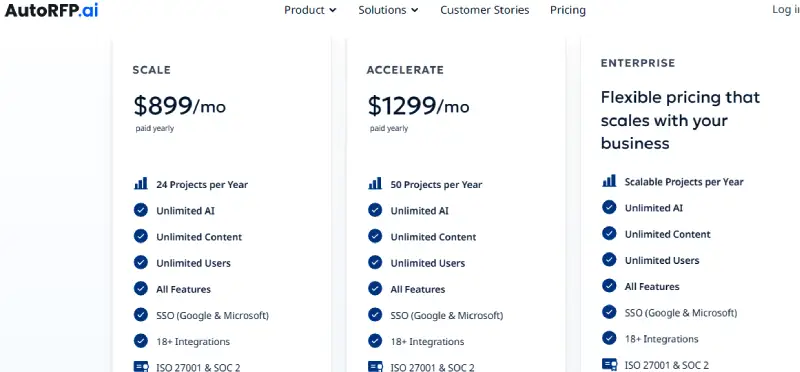
Pricing
Best for
They want to reduce the response time of the RFP. It enhances the standard of proposals using AI. You can avoid the repair of the normal library.
2. Loopio
Loopio is an AI tool for creating proposal replies. It offers reliable answers, easy interpretation, and a joint effort for the task.
Characteristics
- Content collection: The collection of content shows AI help.
- Workflow management: There is proper execution of workflow using this AI tool.
- Link through CRM tools: There is a link with the CRM tools.
- Link the platform with various groups: The website offers group activities. It starts from small to medium.
Pros
- It has a friendly user interface.
- Automation shows AI help.
- Content collection is quite strong for the right response.
- Strong tools for cooperative work.
- Link with major tools for conducting business.
Cons
- It should improve the learning ability.
- We have to fill up the gap in the context.
- The user expects optimization of the content library.
- We must improve the precision.
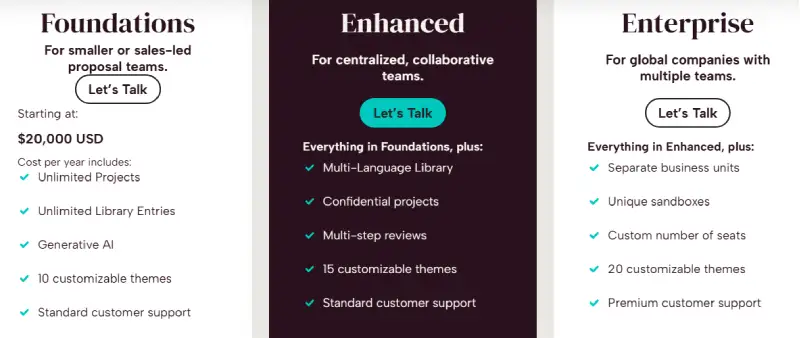
Pricing
Best for
This is for companies using tools with sizes from small to medium.
3. Responsive (RFPIO)
Responsive is an AI tool for increasing sales. It helps proposal groups. There are buyer and security questionnaires with RFPs.
Characteristics
- Collaboration: This AI tool helps in successful teamwork.
- Automation of response: This AI tool gives an automatic response. It increases the pace of work.
- Content management process: The user can deal with content.
- Integration: The connection shows flexibility across different areas.
Pros
- Ensures the safety of data.
- Links business tools like Google Drive and Microsoft Office.
- Points out duplicate content and keeps the originality.
- Improves the pace.
Cons
- The tools must be upgraded regularly.
- The AI tool should reveal the charges.
- The tool has to enhance the level of accuracy.
- This tool is good for big projects.
- There should be an improvement in the platform.
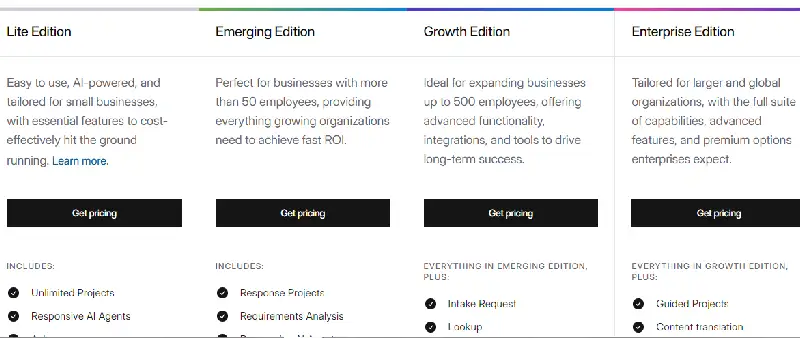
Pricing
Best for
This is perfect for companies. It searches for features in the workflow. It has a high level of joint effort.
AI RFP Tools vs Manual Proposal Writing
| Manual Proposal Writing | AI RFP Tools |
| 12 to 20 hours per RFP. | 2 to 3 hours for an AI first draft and content autorefilling. |
| Previous papers, manual folders, and email. | The knowledge base is searchable and central. It reaches old records. |
| The connection between the spreadsheet, doc and email needs improvement. | Control of version, live projects, and engagement activities. |
| The right format and revision before posting are present. | Formatting using AI and automatic approval of the compliance area. |
| Time is valuable, and so we have to use the time in the right way. | There is growth in some areas. |
| Focus on direct output. | There are auto alerts. |
| It focuses on the manual work of the people. | Replies to RFPs. |
How to Select The Perfect RFP Tool for Small Business
- Pricing: The price is a major factor, and we have to buy an RFP tool at an affordable price.
- Integration: The tool works with different applications, such as Google Docs and others.
- Simplicity of application: Anybody must be able to use the AI tool.
- Standard of AI: The AI must work and give the best result.
- Characteristics of partnership: The AI tool must have the qualities of a partnership.
Real Example of AI-Powered RFP Tools
The genuine examples are as follows:
Chris D. says, “AutoRFP.ai is different from legacy solutions that make you manage the Q&A pairs. Instead, AutoRFP.ai uses context clues. It includes recency to understand how well a previous answer applies to a new question. It removes the overhead of intensive library management.”
Future of AI in Proposal Writing and RFP Automation
The future of AI-powered RFP software is as follows:
- Proposals using Generative AI: The development of proposals improves through generative AI. It improves the speed of previous content analysis.
- Predictive scoring of proposal: RFP tools will enhance the predictive scoring. It will help machine learning and artificial intelligence to handle information. It will examine the chances of proposal writing or closing the agreement.
- Personal RFP replies: It solves the problems of the client. It handles their needs and targets.
- High-level compliance automation: There is regular compliance monitoring. It involves an automated workflow and AI-supported mapping.
Conclusion
AI-powered RFP tools are changing the operation of small businesses. It replies to the appeals of the proposal. You can use automation for routine activities. It increases cooperation. It ensures agreement. Using the tools, you can focus on planning and modification.
You can use artificial intelligence in the RFP process. It is going to increase to a great extent. Small businesses choose RFP automation tools. They will get a lot of benefits. It will reply and produce outstanding proposals. Finally, it will improve the likelihood of contracts. This is the ultimate dream of every business owner.
FAQ
What are AI-powered RFP tools?
AI RFP tools are websites to write proposals in an automatic way. It has a library of content. It gives the best reply.
Can AI increase proposal win rates?
AI can write an excellent proposal. It will help the business through a good proposal.
Which AI tools are best for RFP responses?
The popular tools include Responsive (RFPIO), Loopio and AutoRFP AI.
Are AI RFP tools suitable for small businesses?
Yes, they are perfect for small business owners. They save time and decrease expenditure. It enhances the standard of the proposal.